
Healthcare Whistleblower Rewards

Dedicated healthcare workers enter the profession with a strong desire to help others. So, if you work in a healthcare setting and discover someone committing an illegal act it is very upsetting and confusing. What steps should you take in this situation? If you suspect one or more of your fellow employees is committing fraud, putting patients’ lives at risk or participating in financial misconduct, contact an experienced, healthcare whistleblower attorney immediately.
Before deciding whether to report your concerns internally, to a government agency, or through another channel, consider speaking with an experienced whistleblower attorney. The appropriate reporting strategy can depend on the specific facts, whether a potential False Claims Act claim exists, and whether confidentiality or retaliation concerns are involved. An attorney can also advise you about preserving relevant information without improperly accessing, copying, or removing records you are not authorized to possess.
Healthcare Whistleblower Process
Healthcare fraud involving programs such as Medicare or Medicaid may give rise to claims under the federal False Claims Act. When a potential qui tam action is involved, federal filing requirements, confidentiality rules, and procedural requirements can make experienced legal guidance particularly important. Each case is different. However, the following steps may be recommended by your attorney:
- Document what you have observed and preserve information that is already lawfully in your possession. Potential whistleblowers should be cautious about accessing, copying, forwarding, or removing employer records they are not authorized to possess, particularly records containing protected health information, confidential business information, or privileged communications. An attorney can help determine what information may be appropriate to preserve or disclose.
- Hire an experienced whistleblower attorney. An attorney can evaluate whether the facts may support a False Claims Act qui tam action and advise you about the appropriate reporting strategy. Depending on the circumstances, the timing of internal reports, government disclosures, and a potential court filing can raise important legal and strategic considerations.
- Determine how to proceed with your attorney’s guidance. If a False Claims Act qui tam action is appropriate, the complaint is filed in federal court under seal and generally remains sealed for at least 60 days while the government evaluates the allegations. The government may request additional time to investigate before deciding whether to intervene in the case.
- Understand your whistleblower protections. The False Claims Act prohibits certain forms of retaliation against employees, contractors, and agents for qualifying whistleblower activity. Depending on the circumstances, an individual who experiences unlawful retaliation may be entitled to remedies such as reinstatement, double back pay, interest, certain damages, litigation costs, and reasonable attorneys’ fees.
Timing can also be important in a potential qui tam case. Under the False Claims Act’s first-to-file rule, another private party generally cannot bring a related action based on the same underlying facts while an earlier-filed action is pending. For that reason, someone who believes they have information about healthcare fraud may want to speak with an attorney promptly rather than delaying while deciding how to proceed.
Healthcare Whistleblower Financial Rewards
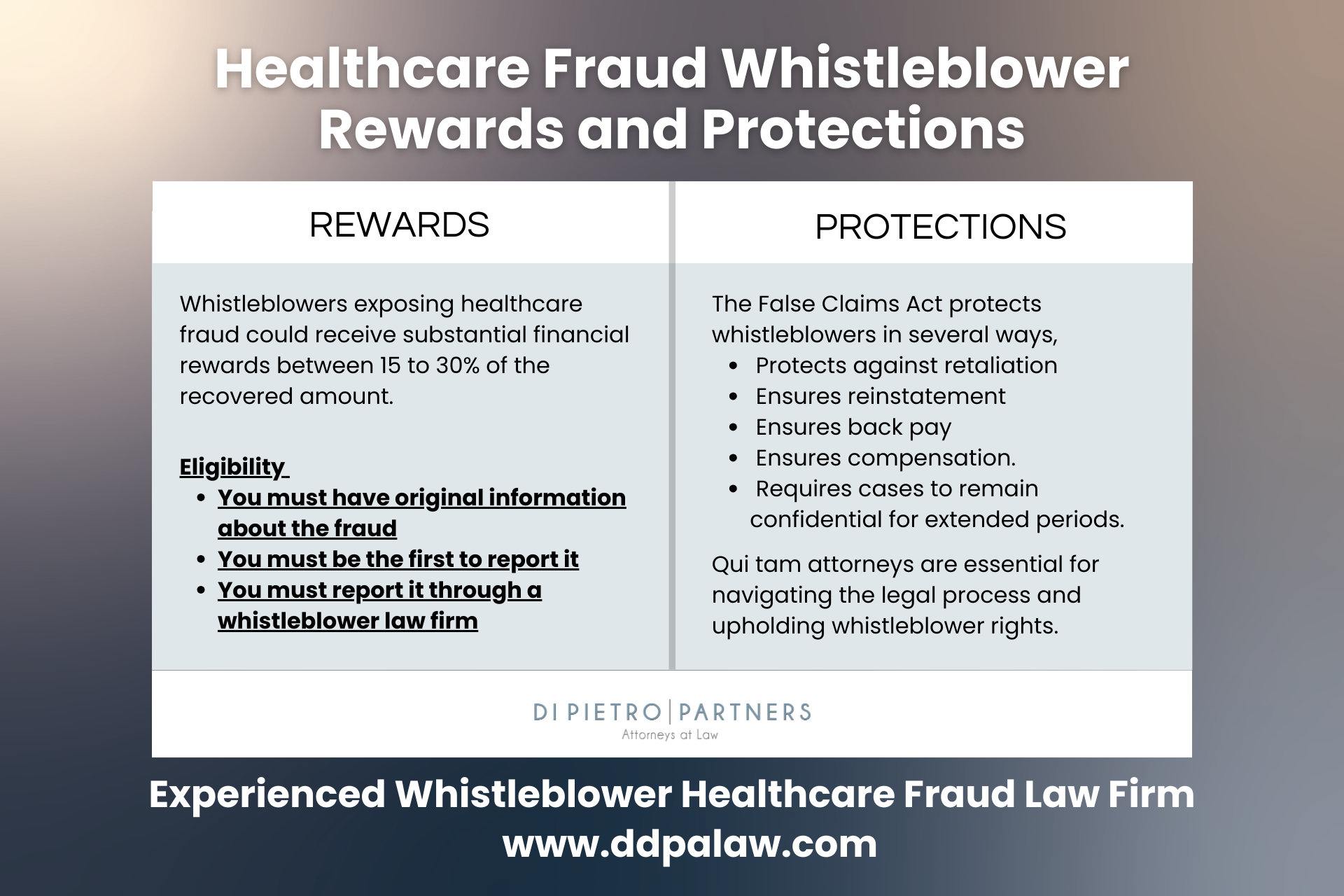
Under the federal False Claims Act, eligible whistleblowers who file a successful qui tam action may receive a percentage of the government’s recovery. If the government intervenes and proceeds with the case, the relator generally receives between 15% and 25% of the proceeds of the action or settlement. If the government declines to intervene and the relator successfully pursues the action, the relator generally receives between 25% and 30%. These percentages are subject to statutory exceptions and may be reduced in certain circumstances.
A whistleblower’s own involvement in the alleged misconduct can affect eligibility for or the amount of an award. If the court finds that a relator planned and initiated the False Claims Act violation, the court may reduce the relator’s share. A relator who is convicted of criminal conduct arising from their role in the violation is not entitled to a share of the recovery. When multiple relators bring the same action, any relator’s share may also need to be allocated among them.
Healthcare Whistleblower Settlements
One of the largest individual whistleblower awards in False Claims Act history was approximately $266.4 million to Michael Bawduniak in 2022. He alleged that Biogen paid improper remuneration to physicians to induce prescriptions of multiple sclerosis drugs, including Tecfidera, resulting in false claims to Medicare and Medicaid.
Biogen agreed to pay $900 million to resolve the allegations, including approximately $843.8 million to the federal government and $56.2 million to 15 states. The federal government did not intervene in the case, and Bawduniak continued pursuing the action. He ultimately received approximately 29.6% of the federal settlement proceeds. The settlement resolved allegations and did not constitute a determination of liability.
Other significant healthcare False Claims Act settlements and whistleblower awards include:
Kaiser Permanente – $556 Million Settlement / $95 Million Relator Share: In 2026, Kaiser Permanente affiliates agreed to pay $556 million to resolve False Claims Act allegations involving allegedly invalid diagnosis codes submitted for Medicare Advantage enrollees. The cases were brought by two former Kaiser employees under the FCA’s qui tam provisions, and DOJ reported a $95 million relator share.
Johnson & Johnson – More Than $2.2 Billion Resolution / More Than $167 Million in Whistleblower Shares: Johnson & Johnson and its subsidiaries entered a criminal and civil resolution exceeding $2.2 billion involving allegations related to prescription-drug marketing and kickbacks. Multiple False Claims Act whistleblower cases contributed to the civil settlements. DOJ reported whistleblower shares of $112 million, $27.7 million, and $28 million from the federal recovery.
Pfizer – $2.3 Billion Resolution / More Than $102 Million to Whistleblowers: Pfizer entered a $2.3 billion criminal and civil resolution involving the marketing of pharmaceutical products. Qui tam lawsuits filed under the False Claims Act helped trigger the investigation, and DOJ reported that six whistleblowers received more than $102 million from the federal civil recovery.
Bristol-Myers Squibb – More Than $515 Million Settlement / Approximately $50 Million to Relators: Bristol-Myers Squibb agreed to pay more than $515 million to resolve civil allegations involving drug marketing and pricing practices. Multiple qui tam actions were involved, and the relators received approximately $50 million as their share of the settlement.
Covenant Healthcare System – More Than $69 Million Settlement / Approximately $12.4 Million Whistleblower Award: Covenant Healthcare System and two physicians resolved False Claims Act allegations involving allegedly improper financial relationships with referring physicians. The claims originated from a qui tam lawsuit, and the whistleblower received approximately $12.38 million from the related settlements.
Ascension Michigan – $2.8 Million Settlement / $532,000 to Relators: Ascension Michigan and related hospitals agreed to pay $2.8 million to resolve False Claims Act allegations involving allegedly medically unnecessary procedures and other services billed to federal healthcare programs. Three whistleblowers brought the claims, and DOJ reported that they received a combined $532,000.
The settlements described above resolved allegations and, except where otherwise stated, did not constitute determinations of civil liability.
According to the U.S. Department of Justice, 458 new healthcare-related qui tam matters were filed in fiscal year 2025, and relator share awards in healthcare-related False Claims Act matters totaled approximately $262.7 million. Healthcare fraud remained one of the leading areas of False Claims Act enforcement, including cases involving kickbacks, medically unnecessary care, improper Medicare Advantage coding, and other false claims submitted to federal healthcare programs. If you suspect fraud involving Medicare, Medicaid, TRICARE, or another government healthcare program, consider speaking with an experienced healthcare whistleblower attorney about your options.
Does Reporting Healthcare Fraud Automatically Qualify You for a Reward?
Simply reporting suspected healthcare fraud does not automatically entitle someone to a whistleblower reward. Under the False Claims Act, relator awards generally arise from a successful qui tam action that results in a recovery for the government. Reporting concerns internally or submitting information to a government agency may be important in some circumstances, but those actions alone are not the same as filing a qui tam lawsuit under the False Claims Act.
What Determines the Amount of a Healthcare Whistleblower Reward?
The percentage a whistleblower receives is not automatic. When the government intervenes in a False Claims Act case, the relator’s share generally ranges from 15% to 25% and depends in part on the extent to which the relator substantially contributed to the prosecution of the action. In certain cases based primarily on information that was already publicly disclosed, the court may award a smaller percentage. If the government declines to intervene and the relator successfully pursues the action, the statutory range is generally 25% to 30%.
When Is a Healthcare Whistleblower Reward Paid?
A healthcare whistleblower reward is not paid simply because a False Claims Act case is filed. A relator generally becomes eligible for a share only if the government obtains a recovery through a settlement or judgment. The relator’s percentage must then be determined under the False Claims Act. Because qui tam cases may involve lengthy government investigations, litigation, settlement negotiations, and disputes over the relator’s share, payment can occur well after the initial filing.
Speak With a Healthcare Whistleblower Attorney
If you have information about suspected fraud involving Medicare, Medicaid, TRICARE, or another government healthcare program, Di Pietro Partners can evaluate whether the facts may support a False Claims Act or qui tam matter. The firm handles qualifying healthcare whistleblower cases nationwide and offers free, confidential consultations.
Contact Di Pietro Partners to discuss your potential healthcare whistleblower claim.
