
In Florida’s complex and highly regulated healthcare laws, physicians face unique legal challenges. To thrive in such a setting, it’s crucial for doctors and medical professionals to comply with an array of federal, state, and local regulations.
A Florida physician contract lawyer is instrumental in guiding healthcare professionals through the legal intricacies specific to the state, especially regarding contracts that define their roles and responsibilities.
Roles and Responsibilities of a Physician Contract Lawyer
A physician contract lawyer in Florida is a legal professional who focuses on the contractual needs of physicians within the state’s healthcare industry. Their work may include drafting, reviewing, negotiating, and evaluating agreements involving physicians, such as employment agreements, partnership and shareholder agreements, independent contractor agreements, medical director agreements, and practice group contracts.
Key Responsibilities Include:
- Drafting and Reviewing Contracts: These lawyers prepare and review agreements governing relationships between physicians, medical groups, hospitals, and other healthcare entities. They can identify legal and business risks, clarify contractual obligations, and help structure terms consistent with applicable law and the physician’s objectives.
- Negotiating Contracts: They advocate for physicians in contract negotiations, aiming to secure terms that align with the medical professional’s goals and practice requirements. Their skill set includes addressing potential challenges and facilitating mutually beneficial agreements.
- Compliance with Regulations: Physician contract lawyers help ensure adherence to both federal laws and Florida-specific regulations, including HIPAA, the Stark Law, the Anti-Kickback Statute, and other regulatory requirements when relevant to the arrangement.
- Dispute Resolution: When contractual disagreements arise, physician contract lawyers may represent clients through negotiation, mediation, arbitration, or litigation, depending on the agreement and circumstances of the dispute.
- Risk Management: By offering specialized legal advice, they assist physicians in minimizing risks and liabilities linked to their contractual duties.
Types of Florida Physician Contracts
Employment Agreements: Contracts outlining terms of employment for physicians working in hospitals, clinics, or medical groups. These detail salary, benefits, duties, and termination clauses.
Partnership Agreements: For physicians entering into partnerships with other healthcare providers or joining a practice group, detailing the terms of partnership, profit sharing, and operational responsibilities.
Independent Contractor Agreements: Used when physicians provide services on a non-employee basis, specifying the nature of work, compensation, and terms of the contractual relationship.
Non-Compete Agreements: These provisions may restrict a physician’s ability to compete, solicit patients or employees, or practice within a defined area after leaving a medical practice or healthcare organization. Whether a particular restriction is enforceable depends on the agreement, the circumstances, and applicable Florida law, including rules that may apply specifically to physicians.
Confidentiality Agreements: To protect sensitive patient and practice information, these agreements bind physicians to confidentiality regarding practice operations and patient data.
Buy-Sell Agreements: In multi-physician practices, these outline the process for buying out a partner’s share in the event of retirement, death, or departure from the practice.
Professional Liability Insurance Agreements: These agreements address malpractice coverage, policy limits, exclusions, defense obligations, tail coverage, and other insurance terms that may affect a physician’s professional and financial risk.
Managed Care Contracts: Agreements between physicians and managed care organizations (MCOs) or insurance providers, outlining the terms of care provision and reimbursement.
What Should a Physician Review Before Signing a Contract?
Before signing an employment agreement or other physician contract, it is important to understand how the agreement may affect your compensation, professional responsibilities, future career options, and potential financial obligations.
Key provisions to review may include:
- Compensation structure: Base salary, productivity formulas, bonuses, collections-based compensation, and other incentive terms.
- Duties and expectations: Clinical responsibilities, call coverage, administrative duties, work locations, scheduling, and productivity requirements.
- Termination provisions: Whether the agreement can be terminated with or without cause, required notice periods, and what happens after termination.
- Non-compete and non-solicitation provisions: Restrictions that may affect where or how you can practice after leaving the organization.
- Professional liability coverage: Who provides malpractice insurance and whether tail coverage or other post-employment coverage may be required.
- Benefits and expenses: Health insurance, retirement benefits, continuing medical education, licensing fees, professional memberships, and other expenses.
- Ownership and partnership opportunities: Whether the agreement provides a path to equity, partnership, or ownership in the practice.
- Dispute-resolution provisions: Whether disputes must proceed through arbitration, mediation, litigation, or another process.
A physician contract attorney can help identify provisions that may create unexpected financial, legal, or professional consequences before the agreement is signed.
When Should a Physician Have a Contract Reviewed?
A physician should consider having an agreement reviewed before signing when the contract could affect compensation, professional responsibilities, ownership rights, or the ability to practice after the relationship ends. Contract review can also be important after an agreement has already been signed, particularly when a physician is considering leaving a practice, facing termination, renegotiating terms, or trying to understand existing contractual obligations.
Review is especially important for physicians entering their first employment agreement or negotiating restrictive provisions such as a non-compete. It may also be appropriate when entering an employment or independent contractor agreement, joining a medical practice, acquiring an ownership interest in a practice, accepting a medical director position, or negotiating other agreements governing a professional relationship.
Reviewing an agreement early can provide more opportunity to address unclear or unfavorable provisions through negotiation. When a contract is already in effect, an attorney can help the physician understand the existing terms and evaluate available options before taking action.
Physician Compensation and Productivity Terms
Physician compensation agreements can involve more than a stated salary. Depending on the arrangement, compensation may include a base salary, productivity incentives, collections-based compensation, bonuses, or other performance-based payments. Physicians should understand how each component is calculated and what conditions must be met before additional compensation is earned.
Contract terms should also clearly address when compensation is paid, how productivity or performance is measured, whether the employer can modify the compensation formula, and what happens to unpaid bonuses or other compensation when the agreement ends.
A physician contract lawyer can review these provisions for unclear terms or financial risks and help negotiate compensation provisions before the agreement is signed.
Termination and What Happens When a Physician Leaves
A physician contract should clearly explain how the professional relationship can end and what obligations continue afterward. Termination provisions may address whether either party can end the agreement with or without cause, how much advance notice is required, and whether certain compensation or bonuses remain payable after departure.
Physicians should also review provisions involving repayment or reconciliation obligations, malpractice or tail coverage, non-compete and non-solicitation restrictions, confidentiality obligations, and other responsibilities that may continue after the agreement ends. Understanding these terms before signing can help a physician evaluate the financial and professional consequences of leaving a practice later.
Florida Physician Non-Competes and Restrictive Covenants
Non-compete and other restrictive covenant provisions can have significant consequences for physicians who later leave a medical practice. These provisions may limit where a physician can practice, the type of work they can perform, or certain activities involving patients, employees, or competing practices after the relationship ends.
Florida law permits enforcement of certain restrictive covenants when statutory requirements are satisfied, including requirements concerning legitimate business interests and the reasonableness of the restriction. Florida law also contains a physician-specific exception that can make a restrictive covenant unenforceable under particular circumstances involving the availability of physicians within a medical specialty in a county.
Because enforceability depends on the language of the agreement and the circumstances involved, physicians should have restrictive covenant provisions reviewed before signing a contract or making decisions about leaving a practice. Physicians already involved in a dispute can learn more about our healthcare non-compete litigation practice.
Florida Physician Contract Example
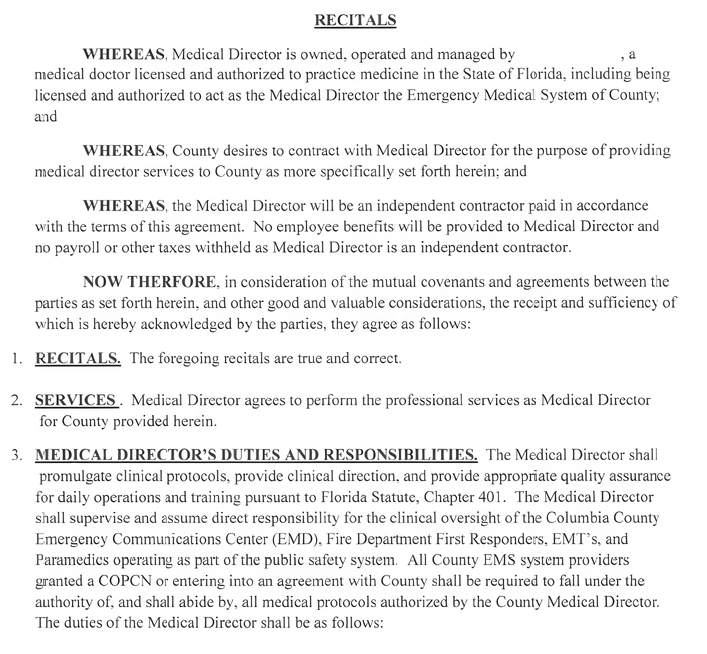
Here’s an example of a Florida physician contract, specifically, a Medical Director Agreement between a physician and a county in Florida. It specifies the terms of engagement for the physician’s role as Medical Director for the county’s Emergency Medical System. The contract details the services to be provided, compensation, and insurance requirements. It focuses on the physician’s responsibilities in overseeing clinical protocols, supervising medical aspects, and ensuring quality assurance for emergency medical services within the county.
Why a Physician Contract Lawyer is Vital in Florida’s Healthcare Sector
Navigating State-Specific Laws: Knowledge of Florida’s unique healthcare statutes and regulations is essential for compliance and successful medical practice.
Protecting Physician Interests: Physician contract lawyers can identify unfavorable terms, clarify contractual obligations, and negotiate provisions that better align with the physician’s professional and business interests while considering applicable legal requirements.
Facilitating Collaborative Agreements: Effective cooperation among healthcare entities is crucial, and physician contract lawyers help forge agreements that promote beneficial partnerships.
Mitigating Risks: Legal guidance from these lawyers helps identify and address potential contractual risks, safeguarding physicians’ practices.
Resolving Disputes Efficiently: Their expertise in dispute resolution helps address conflicts effectively, preserving professional reputations and interests.
Why Choose Di Pietro Partners for Physician Contract Matters?
Physician contracts can involve more than ordinary employment terms. Compensation structures, restrictive covenants, malpractice coverage, ownership rights, regulatory requirements, and post-employment obligations can all affect a physician’s professional and financial interests.
Di Pietro Partners represents physicians and other healthcare professionals in matters involving healthcare contracts, regulatory issues, business relationships, and disputes. The firm combines healthcare law and litigation experience with firsthand familiarity with the healthcare industry. Founder and Managing Partner David Di Pietro previously served as Chairman of Broward Health, giving the firm additional perspective on the legal and operational issues that arise within healthcare organizations.
Whether you are reviewing your first physician employment agreement, negotiating compensation or restrictive covenants, entering a partnership or medical director arrangement, or dealing with an existing contract dispute, our attorneys can help you understand the terms, identify potential risks, and evaluate your options.
Our main office is located in Fort Lauderdale, and we maintain additional Florida office locations by appointment, including Miami, West Palm Beach, Fort Myers, Orlando, Tampa, and Jacksonville. We represent physicians and other healthcare professionals statewide in matters involving employment agreements, restrictive covenants, compensation terms, partnership and ownership arrangements, medical director agreements, and physician contract disputes.
If you need assistance reviewing, negotiating, or resolving a dispute involving a physician contract, contact Di Pietro Partners today for a free and confidential consultation with an experienced Florida physician contract lawyer.