

Surgical Error Lawyer
Florida Malpractice Lawyers For Surgical Errors
Surgical errors are extremely frightening to imagine, let alone experience. Before “going under the knife,” we generally trust that surgeons and medical staff have the necessary training, education, and experience to provide care consistent with the applicable professional standard of care. Although pain, discomfort, and complications can occur after surgery even when appropriate care is provided, preventable errors can sometimes result in serious injury, permanent disability, or wrongful death.
If you or a loved one was injured because of a surgical error or another form of medical malpractice in Florida, it is important to have your case reviewed promptly because Florida medical malpractice claims are subject to strict filing deadlines.
Di Pietro Partners handles qualifying medical malpractice cases on a contingency-fee basis. Contact our office for a free, confidential case evaluation.
 Determining If You Have A Case
Although each case is different and may have a special set of circumstances, there’s several general guidelines in determining a malpractice case. These guidelines include:
NOT MALPRACTICE
- A poor outcome or complication following surgery does not automatically mean medical malpractice occurred. Surgical procedures carry known risks, and complications can arise even when the surgeon and medical team provide appropriate care.
- Generally, a malpractice claim requires evidence that a healthcare provider failed to meet the applicable professional standard of care and that this failure caused or contributed to the patient’s injury.
MALPRACTICE
- A formal patient-doctor relationship must be established (general advice is not sufficient).
- The surgeon or another healthcare provider must have breached the applicable professional standard of care. Examples may include failing to properly sterilize surgical instruments, leaving a surgical object inside a patient, or certain anesthesia-related errors.
- The patient must have suffered damages as a result, such as additional medical expenses, lost income, pain and suffering, or disability.
Common Surgical Errors
Surgical instruments or objects left in a patient – Failure to count all tools used during a surgical procedure, Whether a forgotten object is a soft pad of gauze or a sharp pair of scissors, the end result can be blockage, organ damage, internal bleeding, or death.
Organ or nerve damage – These errors often involve the surgeon mishandling the scalpel or other medical instrument and cutting a nerve, tendon, etc. Mishaps like these can be extremely serious and result in life-long pain and disability for the patient.
Anesthesia errors – Errors involving anesthesia may include administering an incorrect dosage, failing to properly monitor the patient, or failing to respond appropriately to complications. In serious cases, anesthesia-related errors can result in oxygen deprivation, brain injury, or other significant harm.
Improper sterilization – Failure to properly sterilize medical equipment used during the course of the surgery exposes the patient to health risks such as infection.
Performing surgery on the wrong body part – It’s not unheard of for surgeons to operate on the incorrect body part. This has occurred even with amputations.
Wrong procedure or wrong-patient surgery – Surgical teams generally use preoperative verification and other safety procedures to confirm the correct patient, procedure, and surgical site. Failure to follow appropriate safeguards can contribute to serious preventable errors.
Surgical Error Statute of Limitations
Florida’s medical malpractice laws can be difficult to navigate and understand. A patient bringing a surgical malpractice claim generally must prove that a healthcare provider breached the applicable professional standard of care and that the breach caused or contributed to the patient’s injury. Florida also requires a presuit investigation supported by a verified written opinion from a qualified medical expert before a medical negligence lawsuit is filed.
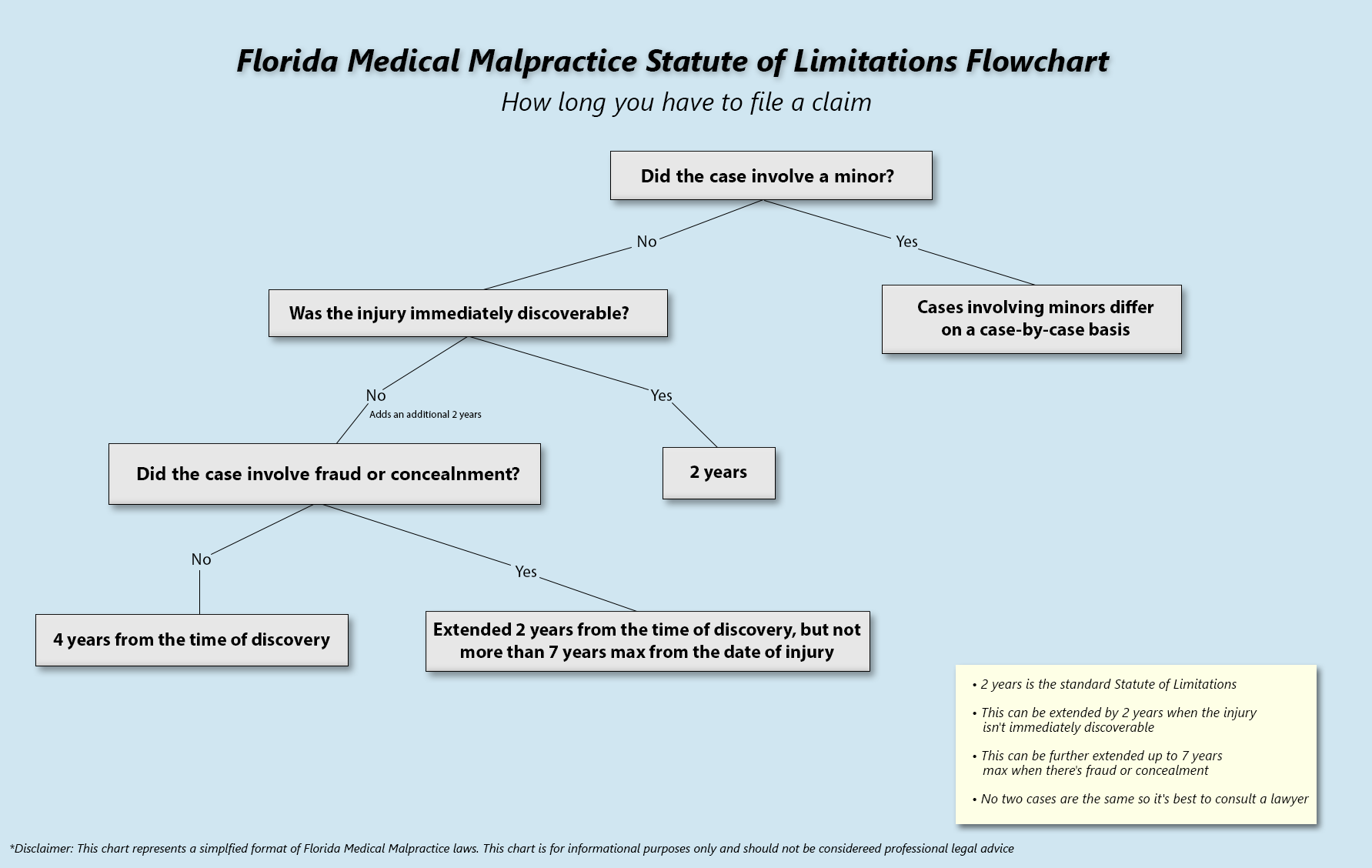
Under Florida law, a medical malpractice action generally must be commenced within two years from the incident or from when the incident was discovered, or reasonably should have been discovered with due diligence. In most cases, a four-year statute of repose also limits how long after the underlying incident a claim may be brought.
Limited exceptions can apply. Florida law contains special provisions for certain claims involving minors. When fraud, concealment, or intentional misrepresentation prevented discovery of the injury, the deadline may also be extended, subject generally to a seven-year outside limit from the incident.
Because determining when a medical malpractice deadline begins or expires can depend on the specific facts of the case, it is important to have a potential surgical-error claim reviewed as soon as possible.
Why Choose Di Pietro Partners for a Medical Malpractice Claim Involving a Surgical Error?
Surgical malpractice cases often involve complex questions about what occurred during the procedure, whether the surgical team followed the applicable standard of care, and whether an error caused the patient’s injuries. Evaluating these claims may require detailed review of operative reports, medical records, imaging, postoperative care, and other medical evidence.
Di Pietro Partners combines medical malpractice litigation experience with physician-level medical insight. Founder David Di Pietro has more than 20 years of litigation experience, including medical malpractice and healthcare-related matters, while Dr. Tiffany Di Pietro serves as the firm’s Medical Advisor and is a licensed Florida physician who is quadruple board-certified in Internal Medicine, Cardiology, Echocardiography, and Nuclear Cardiology.
This combination allows the firm to evaluate both the legal and medical issues involved in serious surgical-injury claims.
Suffering From Complications?
Our attorneys are experienced in medical malpractice cases involving surgical errors. Depending on the specific facts of a claim, a patient may be able to recover compensation for damages such as medical expenses, lost income, pain and suffering, disability, and other losses caused by the malpractice.
Not every surgical complication is the result of negligence, so determining whether malpractice occurred requires a careful review of the surgery, the patient’s medical records, and the circumstances surrounding the injury.
If you or a loved one suffered serious harm following surgery and believe a medical error may have been involved, contact Di Pietro Partners for a free and confidential case evaluation.
Di Pietro Partners handles qualifying medical malpractice cases on a contingency-fee basis, meaning attorney fees are generally contingent on obtaining a recovery.