
Healthcare Whistleblower Guide (2026 Edition)
Healthcare fraud costs the United States tens of billions of dollars every year, with schemes involving Medicare, Medicaid, private insurers, and federal healthcare programs.
Whistleblowers play a critical role in exposing fraud committed by hospitals, physicians, pharmaceutical companies, laboratories, and medical suppliers. Many of the largest healthcare fraud recoveries in U.S. history began with insiders who recognized illegal conduct and reported it under federal whistleblower laws.
This guide explains:
- What healthcare fraud looks like
- How whistleblower lawsuits work
- The laws that protect whistleblowers
- Potential financial rewards
- How investigations and cases unfold
— Table of Contents —
- What Is a Healthcare Whistleblower?
- Why Healthcare Fraud Is So Common
- Major Healthcare Fraud Schemes
- The False Claims Act Explained
- Who Can Become a Whistleblower
- Financial Rewards for Whistleblowers
- Step-by-Step: How a Whistleblower Case Works
- Common Evidence in Healthcare Fraud Cases
- Risks and Protections for Whistleblowers
- How Federal Investigations Work
- Healthcare Whistleblower FAQ
- Attorney Review & Legal Oversight
What Is a Healthcare Whistleblower?
A healthcare whistleblower is an individual who reports fraud involving government healthcare programs such as:
These individuals often have inside knowledge of fraudulent activity occurring within healthcare organizations, including hospitals, medical practices, pharmaceutical companies, laboratories, medical equipment suppliers, and insurance billing operations.
Healthcare fraud frequently involves false billing, kickbacks, medically unnecessary services, or other schemes designed to improperly obtain money from federal healthcare programs. Because these programs process millions of claims each day, fraudulent activity can sometimes go undetected without information from insiders who are familiar with how the schemes operate.
Most healthcare whistleblower cases are filed under the Federal False Claims Act. This law allows private individuals to bring lawsuits on behalf of the United States government when they have knowledge that a person or company knowingly submitted false claims for government funds.
These lawsuits are known as qui tam actions, a legal term derived from Latin meaning “who sues on behalf of the king as well as for himself.” In a qui tam case, the whistleblower files the lawsuit confidentially in federal court while the government investigates the allegations.
If the government recovers money through a settlement or court judgment, the whistleblower may receive a portion of the recovery as a financial reward. Under the False Claims Act, whistleblowers are typically entitled to 15 percent to 30 percent of the government’s recovery, depending on factors such as the significance of the information provided and the whistleblower’s role in assisting the investigation.
Healthcare whistleblower cases have led to many of the largest healthcare fraud recoveries in the United States, helping federal authorities identify and stop fraudulent billing schemes that could otherwise continue for years.
Why Healthcare Fraud Is So Common
Healthcare is one of the largest sectors of the U.S. economy, representing more than $4 trillion in annual spending. A substantial portion of this spending flows through federal healthcare programs such as Medicare, Medicaid, TRICARE, and other government-funded health systems.
The size and complexity of the healthcare industry create an environment where fraudulent billing practices and illegal financial arrangements can occur. While most healthcare providers operate ethically, the financial incentives within the system can create opportunities for fraud in certain situations.
Several factors contribute to the elevated risk of healthcare fraud.
Complex Billing Systems
Medical billing is highly complex and relies on detailed coding systems such as CPT codes, ICD diagnosis codes, and billing modifiers. These coding systems determine how services are reimbursed by government healthcare programs.
Because thousands of billing codes exist and reimbursement rules are constantly evolving, it can be difficult for regulators to quickly identify improper billing practices. Fraudulent actors may exploit this complexity by submitting false claims, upcoding services, or billing for procedures that were never performed.
High Reimbursement Rates
Certain medical services, procedures, and medical equipment reimburse at relatively high rates under federal healthcare programs. When large payments are tied to specific services or treatments, some providers may be tempted to overutilize those services or bill for medically unnecessary procedures.
Fraud schemes may focus on services with higher reimbursement values because they generate larger payments from government healthcare programs.
Limited Oversight in Some Sectors
Although federal and state agencies monitor healthcare billing activity, the sheer volume of claims submitted every day makes it difficult to review every transaction in real time.
Millions of claims are processed daily across Medicare and Medicaid systems. As a result, some fraudulent activity may not be immediately detected through automated billing review systems.
In certain sectors, such as durable medical equipment suppliers, laboratory testing, or home health services, regulators have historically identified patterns of abuse where oversight mechanisms struggled to keep pace with evolving fraud schemes.
Pressure to Increase Revenue
Healthcare organizations operate in a competitive environment where financial performance is often closely monitored. Hospitals, physician practices, and corporate healthcare systems may face pressure to increase revenue, maintain margins, or meet growth targets.
In some cases, this pressure can contribute to improper billing practice, aggressive coding strategies, or illegal financial arrangements designed to generate additional reimbursement from government healthcare programs.
Corporate Healthcare Consolidation
Over the past two decades, the healthcare industry has experienced significant consolidation through hospital acquisitions, private equity investment, and large healthcare system mergers.
As organizations grow larger and more complex, internal oversight and compliance systems can become more difficult to manage effectively. Large corporate structures may also create layers of management where questionable billing practices can develop without immediate detection.
Because of the complexity of healthcare billing systems and the scale of federal healthcare programs, fraudulent practices can sometimes continue for extended periods before they are discovered.
In many cases, whistleblowers provide the first evidence that allows investigators to uncover fraudulent schemes. Individuals working inside healthcare organizations may recognize unusual billing patterns, illegal referral arrangements, or internal communications that indicate improper conduct. When these individuals report fraud, their information can help federal authorities identify violations and recover improperly paid funds.
Major Healthcare Fraud Schemes
Healthcare fraud can occur across nearly every part of the medical system, including hospitals, physician practices, laboratories, pharmacies, medical equipment suppliers, and healthcare management companies.
Fraud schemes often involve improper billing practices, illegal financial relationships, or the submission of false claims to government healthcare programs. Because Medicare, Medicaid, and other federal healthcare programs process enormous volumes of claims each day, fraudulent conduct can sometimes remain hidden until investigators receive information from insiders.
Common healthcare fraud schemes include the following.
Medicare Billing Fraud
One of the most common forms of healthcare fraud involves improper billing to Medicare. Healthcare providers submit claims to Medicare for reimbursement when they treat eligible patients. When providers knowingly submit false or misleading claims, the conduct may violate the False Claims Act.
Medicare billing fraud can take several forms, including billing for services that were:
Never provided
In some cases, providers submit claims for medical services, tests, or procedures that were never actually performed. These “phantom billing” schemes may involve fabricated patient records or falsified documentation designed to make the claims appear legitimate.
Medically unnecessary
Healthcare providers may also bill Medicare for procedures, diagnostic tests, or treatments that are not medically necessary for the patient’s condition. These schemes often occur when providers attempt to increase revenue by ordering excessive testing or procedures that do not meet accepted medical standards.
Upcoded to higher reimbursement codes
Medical services are billed using specific coding systems that determine reimbursement levels. Upcoding occurs when a provider bills for a more complex or expensive service than what was actually performed. By using higher-paying billing codes, providers can improperly increase reimbursement from Medicare.
Performed by unqualified personnel
In some situations, services billed under a physician’s name may actually be performed by individuals who are not properly licensed or qualified to perform the procedure. When providers bill Medicare as if a qualified professional performed the service, the claim may be considered false.
These types of billing schemes can generate significant improper payments over time, particularly when fraudulent claims are submitted repeatedly across large patient populations. As a result, Medicare billing fraud is one of the most common forms of healthcare fraud investigated by federal authorities.
Kickbacks and Illegal Referrals
Another major category of healthcare fraud involves illegal financial relationships between healthcare providers, suppliers, and other organizations. These arrangements often involve payments or benefits intended to influence medical referrals or treatment decisions.
Federal law strictly prohibits healthcare providers from receiving or offering financial incentives in exchange for referring patients for services that are reimbursed by federal healthcare programs.
These schemes are typically prosecuted under two key federal laws: the Anti-Kickback Statute and the Stark Law.
The Anti-Kickback Statute (AKS) makes it illegal to knowingly offer, pay, solicit, or receive anything of value in order to induce or reward referrals for services covered by federal healthcare programs such as Medicare or Medicaid.
Kickbacks can take many forms, including:
- Cash payments
- Consulting or speaking fees that do not reflect legitimate work
- Free rent or office space
- Luxury travel or entertainment
- Medical directorship arrangements with little or no real responsibility
- Equipment, staff, or services provided at no cost
Even indirect financial incentives can violate the law if they are intended to influence referral decisions.
The Stark Law, also known as the Physician Self-Referral Law, prohibits physicians from referring patients for certain designated health services to entities in which they have a financial interest, unless a specific legal exception applies.
For example, a physician may violate Stark Law if they refer patients to:
- A diagnostic laboratory they partially own
- An imaging center where they receive financial distributions
- A medical equipment company in which they hold an ownership interest
These laws are designed to ensure that medical decisions are based on patient needs rather than financial incentives.
Kickback and referral schemes can lead to widespread fraud because the financial relationships encourage providers to generate additional services, tests, or treatments that may not be medically necessary. When these services are billed to federal healthcare programs, the claims may violate the False Claims Act.
Whistleblowers often uncover kickback arrangements through internal communications, contracts, financial records, or discussions between healthcare executives and providers. Because these arrangements may be hidden within complex corporate structures, insider information can be critical to identifying and investigating potential violations.
Durable Medical Equipment (DME) Fraud
Durable Medical Equipment (DME) fraud is one of the most frequently investigated forms of healthcare fraud involving federal healthcare programs. Durable medical equipment includes medically necessary devices that are prescribed for home use, such as mobility aids, respiratory equipment, and orthopedic supports.
Common examples of DME include:
- CPAP and BiPAP machines for sleep apnea
- Wheelchairs and mobility scooters
- Back and knee braces
- Orthopedic supports
- Oxygen equipment
- Prosthetics and other assistive device
Because many of these items are reimbursed by Medicare and other government healthcare programs, fraudulent suppliers may attempt to exploit billing systems in order to obtain improper payments.
DME fraud schemes often involve billing for equipment that was never delivered to the patient, or billing for items that were not medically necessary. In some cases, suppliers obtain patient information through marketing campaigns, telemarketing operations, or third-party lead generators and then submit claims for equipment that patients never requested or did not need.
Other common schemes include:
Billing for equipment not provided
Suppliers may submit claims to Medicare for equipment that was never actually delivered to the patient. These schemes often rely on falsified documentation or fabricated delivery records.
Medically unnecessary braces or devices
Some DME fraud operations target large numbers of Medicare beneficiaries by offering braces or other equipment through aggressive telemarketing campaigns. Physicians may be paid to sign orders for equipment without properly examining the patient or determining whether the device is medically necessary.
Kickbacks for patient referrals
In some schemes, DME suppliers pay commissions or referral fees to marketers, telemedicine companies, or healthcare providers in exchange for patient referrals. These payments may violate the Anti-Kickback Statute when they are tied to services reimbursed by federal healthcare programs.
Upcoding or billing higher-cost equipment
Suppliers may bill for more expensive devices than what the patient actually received. For example, a supplier may deliver a basic brace but bill Medicare for a more advanced and higher-reimbursed device.
DME fraud schemes have been the subject of numerous federal enforcement actions and criminal prosecutions. Because these schemes often involve large volumes of claims submitted across many patients, fraudulent billing can result in substantial losses to federal healthcare programs.
Whistleblowers frequently play a key role in exposing DME fraud. Employees working within medical equipment suppliers, billing companies, or healthcare organizations may observe irregular billing patterns, improper physician orders, or internal communications that indicate fraudulent practices. When reported, this information can help investigators identify and stop ongoing fraud schemes.
Laboratory Fraud
Clinical laboratories play an important role in modern healthcare by performing diagnostic testing that helps physicians detect disease, monitor patient conditions, and guide treatment decisions. However, laboratory services are also an area where fraudulent billing practices can occur, particularly when tests are billed to federal healthcare programs such as Medicare and Medicaid.
Laboratory fraud typically involves submitting claims for diagnostic tests that were not medically necessary, improperly ordered, or never performed. Because laboratory testing can be conducted at high volumes and reimbursed through standardized billing codes, improper practices can generate substantial fraudulent payments if left unchecked.
Common laboratory fraud schemes include the following.
Unnecessary testing
Some laboratories perform extensive panels of diagnostic tests that are not medically necessary for the patient’s condition. Providers may order large numbers of tests in order to increase reimbursement from federal healthcare programs, even when clinical guidelines do not support the testing.
In certain cases, laboratories encourage physicians to order large testing panels that include multiple unnecessary tests bundled together.
Kickbacks for specimen referrals
Laboratories may offer financial incentives to physicians, clinics, or healthcare providers in exchange for referring patient specimens for testing. These payments can take many forms, including consulting agreements, speaker fees, processing payments, or other financial arrangements.
When laboratories pay providers for patient referrals related to services billed to federal healthcare programs, those arrangements may violate the Anti-Kickback Statute and may also lead to liability under the False Claims Act.
Billing for tests not performed
In some fraud schemes, laboratories bill Medicare or Medicaid for diagnostic tests that were never actually conducted. These schemes may involve falsified laboratory records, fabricated test results, or billing for additional tests beyond what was ordered by the physician.
Because laboratories often process large numbers of claims, fraudulent billing practices can generate significant improper payments over time.
Genetic testing scams targeting Medicare patients
In recent years, federal investigators have identified numerous schemes involving unnecessary genetic testing billed to Medicare. These scams often involve marketing companies that target seniors through telemarketing calls, online advertisements, or health fairs.
Patients may be encouraged to provide genetic samples such as cheek swabs, often under the promise of free testing or cancer screening. Fraudulent operators then obtain physician orders through telemedicine arrangements and submit claims to Medicare for expensive genetic tests that were not medically necessary.
These schemes have resulted in major federal enforcement actions, with investigators identifying billions of dollars in fraudulent laboratory testing claims.
Whistleblowers working inside laboratories, diagnostic companies, or billing operations may be among the first individuals to recognize suspicious testing patterns, unusual billing volumes, or internal communications suggesting improper conduct. Their information can be critical in helping federal investigators uncover complex laboratory fraud schemes.
Pharmaceutical Fraud
Pharmaceutical fraud involves illegal practices by drug manufacturers, distributors, or related companies that result in improper payments from federal healthcare programs such as Medicare, Medicaid, and TRICARE. Because prescription medications represent a significant portion of healthcare spending in the United States, fraudulent conduct in the pharmaceutical industry can lead to substantial financial losses for government healthcare programs.
Pharmaceutical fraud cases often involve marketing practices, pricing strategies, or financial arrangements that improperly influence prescribing behavior or result in false reimbursement claims.
Common pharmaceutical fraud schemes include the following.
Off-label drug promotion
The U.S. Food and Drug Administration (FDA) approves medications for specific uses based on clinical testing and safety data. Physicians may legally prescribe medications for “off-label” uses in certain circumstances, but pharmaceutical companies are generally prohibited from marketing drugs for uses that have not been approved by the FDA.
In some cases, drug manufacturers promote medications for unapproved conditions in order to increase sales. When these prescriptions are reimbursed by federal healthcare programs, the resulting claims may be considered false or fraudulent under the False Claims Act.
Kickbacks to physicians
Pharmaceutical companies may attempt to influence prescribing decisions by offering financial incentives to physicians or healthcare providers. These payments can take the form of consulting fees, speaking engagements, research funding, or other financial arrangements.
If these payments are intended to induce physicians to prescribe a particular drug that will be reimbursed by Medicare or Medicaid, the arrangement may violate the Anti-Kickback Statute. Such violations can also lead to liability under the False Claims Act if the resulting prescriptions are billed to federal healthcare programs.
Manipulated clinical data
Pharmaceutical companies conduct clinical trials and research studies to evaluate the safety and effectiveness of new medications. Fraud can occur when companies manipulate or misrepresent clinical trial results in order to obtain regulatory approval or expand market demand for a drug.
Misleading clinical data may influence prescribing practices or regulatory decisions, potentially resulting in widespread reimbursement for drugs that were promoted based on inaccurate or incomplete information.
Inflated drug pricing schemes
Drug pricing practices can also create potential liability when companies manipulate pricing benchmarks used by federal healthcare programs. For example, manufacturers may report artificially inflated pricing data that affects reimbursement formulas used by Medicare or Medicaid.
In some enforcement actions, federal investigators have alleged that pharmaceutical companies improperly reported drug prices or offered hidden discounts and rebates in ways that distorted government reimbursement calculations.
Pharmaceutical fraud cases have resulted in some of the largest healthcare fraud settlements in U.S. history. Because these schemes often involve complex corporate practices and internal decision-making processes, whistleblowers working inside pharmaceutical companies, research organizations, or healthcare marketing firms can play a critical role in helping investigators uncover improper conduct.
The False Claims Act Explained
The False Claims Act (FCA) is the primary federal law used by the United States government to combat fraud involving government programs, including Medicare, Medicaid, TRICARE, and other federally funded healthcare systems. Originally enacted during the Civil War to address fraud by military contractors, the statute has evolved into one of the government’s most powerful tools for identifying and prosecuting healthcare fraud.
The False Claims Act allows private individuals, known as whistleblowers, to file lawsuits against individuals or companies that knowingly submit false or fraudulent claims for payment to the federal government. These lawsuits are filed on behalf of the United States and allow whistleblowers to help federal authorities identify and recover funds obtained through fraud.
Healthcare fraud cases represent the largest category of False Claims Act enforcement actions each year. These cases often involve improper billing practices, illegal referral arrangements, or other schemes that result in fraudulent claims submitted to government healthcare programs.
A key feature of the False Claims Act is its qui tam provision, which allows private individuals to initiate lawsuits when they have knowledge of fraud. When a whistleblower files a qui tam lawsuit, the case is initially filed under seal in federal court, meaning it remains confidential while the government investigates the allegations.
During this period, the U.S. Department of Justice reviews the evidence, conducts its own investigation, and determines whether it will intervene in the case and take over the prosecution.
The False Claims Act also contains significant financial penalties designed to deter fraud and recover taxpayer funds. Key provisions of the statute include:
Treble damages
Defendants found liable under the False Claims Act may be required to pay three times the amount of damages sustained by the government. This provision significantly increases the financial consequences of submitting false claims to federal programs.
Civil penalties per false claim
In addition to treble damages, the law imposes civil penalties for each individual false claim submitted. Because healthcare billing often involves large volumes of claims, these penalties can quickly escalate in cases involving widespread fraudulent billing practices.
Whistleblower rewards
Whistleblowers who file successful False Claims Act cases may receive a financial award ranging from 15 percent to 30 percent of the government’s recovery. The percentage depends on several factors, including the value of the information provided, the whistleblower’s role in assisting the investigation, and whether the government intervenes in the case.
The False Claims Act has led to billions of dollars in recoveries from healthcare fraud cases over the past several decades. Many of these recoveries were made possible because whistleblowers came forward with inside information that allowed federal investigators to uncover fraudulent conduct within healthcare organizations.
Who Can Become a Whistleblower
Healthcare whistleblowers often include individuals who work inside healthcare organizations and have direct knowledge of fraudulent conduct. Because healthcare fraud typically occurs within complex billing systems or corporate structures, insiders are often the first people to recognize suspicious billing practices, illegal referral arrangements, or improper documentation.
Common examples of healthcare whistleblowers include:
- Doctors
- Nurses
- Hospital administrators
- Billing specialists
- Compliance officers
- Medical sales representatives
- Laboratory employees
- Pharmaceutical industry professionals
- Pharmacists
- Healthcare consultants or vendors
In many cases, whistleblowers are individuals who work closely with billing systems, medical records, or financial operations within healthcare organizations. For example, billing staff or compliance officers may notice unusual billing patterns, improper coding practices, or claims submitted for services that were never performed.
However, a whistleblower does not necessarily need to work directly for the healthcare provider committing the fraud. Third-party vendors, contractors, consultants, and other professionals who have access to non-public information about fraudulent conduct may also qualify to file a whistleblower case.
The key requirement is that the individual has non-public information demonstrating that false claims were submitted to the government. This information may come from internal documents, billing records, emails, contracts, or firsthand observations of improper practices.
According to attorney David Di Pietro, whistleblowers often come from a wide range of roles within the healthcare system, including financial officers, nurses, billing personnel, and medical staff who observe fraudulent billing practices or illegal arrangements within their organizations.
In most situations, the only individuals who may be restricted from serving as whistleblowers are attorneys representing the organization involved in the fraud, due to attorney-client privilege rules.
Because healthcare fraud cases often rely on internal information that regulators do not otherwise have access to, whistleblowers play a critical role in helping the government identify fraudulent schemes and recover improperly paid funds.
Financial Rewards for Healthcare Whistleblowers
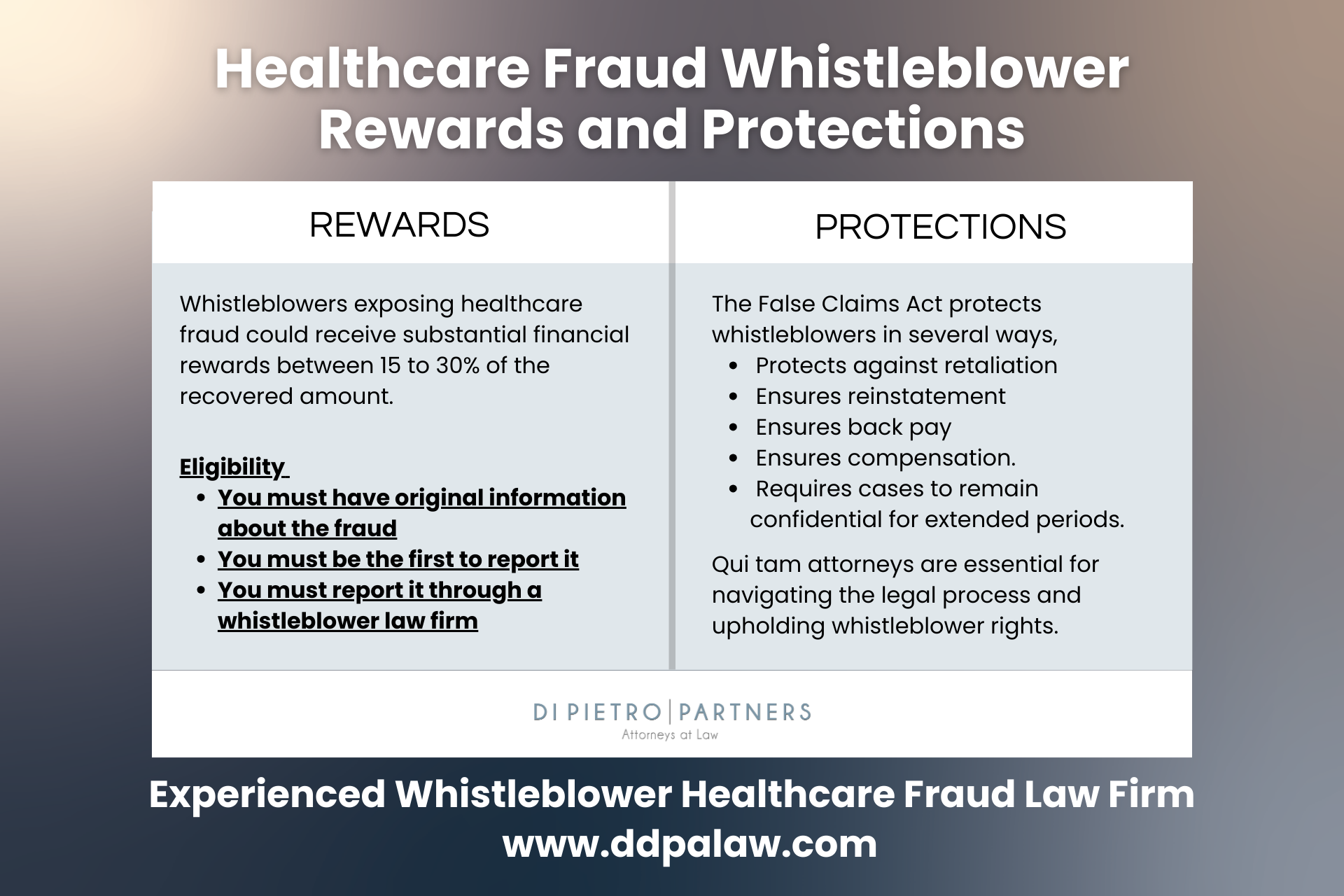
Under the False Claims Act, whistleblowers who report healthcare fraud against federal healthcare programs may be entitled to receive a portion of the government’s financial recovery. When a whistleblower’s information leads to a successful settlement or judgment, the law provides monetary incentives designed to encourage individuals to come forward with credible evidence of fraud.
In most cases, whistleblowers may receive between 15% and 30% of the government’s recovery.
The exact percentage depends on several factors, including:
- Quality of evidence provided by the whistleblower
- Level of cooperation during the government’s investigation
- Government involvement in the case (whether the Department of Justice intervenes)
- Importance of the whistleblower’s information in uncovering the fraud
If the federal government intervenes and takes over the case, whistleblowers typically receive between 15% and 25% of the recovery. If the government declines to intervene and the whistleblower’s attorneys successfully pursue the case independently, the reward may increase to as much as 30%.
Healthcare fraud cases often involve significant financial recoveries because federal healthcare programs process enormous volumes of claims each year. When fraudulent schemes operate over long periods of time, the total damages can grow substantially.
As a result, some healthcare fraud settlements have exceeded tens or even hundreds of millions of dollars, leading to substantial financial awards for whistleblowers. In major national cases involving pharmaceutical companies, hospital systems, or healthcare corporations, settlements have reached billions of dollars.
These financial incentives reflect the important role whistleblowers play in helping the government detect and stop fraud within federal healthcare programs such as Medicare, Medicaid, and TRICARE. By providing information that investigators would not otherwise have access to, whistleblowers help recover taxpayer funds and protect the integrity of the healthcare system.
Step-by-Step: How a Whistleblower Case Works
Healthcare whistleblower cases typically follow a structured legal process under the False Claims Act. These cases are unique because they allow private individuals to file lawsuits on behalf of the United States government when they have evidence that federal funds were obtained through fraud.
Although each case is different, most healthcare whistleblower actions proceed through the following stages.
1. Confidential Consultation with an Attorney
The process usually begins with a confidential consultation between the potential whistleblower and an attorney experienced in False Claims Act litigation. During this initial discussion, the attorney evaluates the information provided, reviews any available documentation, and determines whether the evidence may support a whistleblower claim.
Because healthcare fraud cases often involve sensitive internal information, whistleblowers are generally advised to seek legal guidance before reporting concerns internally or discussing the situation with coworkers.
An experienced attorney can help evaluate the strength of the case and explain the legal protections available to whistleblowers.
2. Filing a Sealed Qui Tam Complaint
If the evidence supports a whistleblower action, the attorney may file a qui tam lawsuit in federal court under the False Claims Act. These lawsuits are filed under seal, meaning they remain confidential and are not immediately disclosed to the defendant.
During the sealed period, the defendant typically does not know that a lawsuit has been filed. This allows the government time to review the allegations and conduct an investigation without alerting the parties accused of fraud.
The whistleblower and their legal team must also provide the government with detailed documentation supporting the allegations.
3. Government Investigation
After the complaint is filed, the Department of Justice (DOJ) begins investigating the allegations. Federal investigators may review medical records, billing data, internal communications, contracts, and other relevant evidence.
Healthcare fraud investigations often involve multiple government agencies, including:
- The Department of Justice (DOJ)
- The Department of Health and Human Services Office of Inspector General (HHS-OIG)
- The Centers for Medicare & Medicaid Services (CMS)
- Federal investigative agencies such as the FBI
Investigations may involve:
- Subpoenas for documents and records
- Interviews with witnesses and company employees
- Analysis of billing and claims data
- Coordination with regulatory agencies overseeing healthcare programs
Because healthcare fraud schemes can be complex and involve large volumes of billing data, government investigations may last several months or even several years.
4. Government Decision
Once the investigation is complete, the government must decide whether to intervene in the case.
If the government intervenes, it takes primary responsibility for prosecuting the lawsuit. The whistleblower and their attorneys may continue to assist in the case, but the Department of Justice typically leads the litigation.
If the government declines to intervene, the whistleblower may still choose to pursue the case independently with their attorneys. In these situations, the whistleblower’s legal team takes the lead in litigating the case on behalf of the government.
5. Settlement or Trial
Many healthcare whistleblower cases ultimately resolve through negotiated settlements between the government and the defendants. Settlements often require companies to repay improperly obtained funds, pay civil penalties, and implement compliance reforms.
In some cases, however, the dispute proceeds to trial in federal court. If the government or whistleblower prevails, the defendants may be required to pay treble damages and additional civil penalties under the False Claims Act.
When the government successfully recovers funds, the whistleblower may receive a percentage of the recovery as a financial reward.
Evidence in Healthcare Fraud Cases
Healthcare whistleblower cases often rely on detailed documentation that demonstrates how fraudulent claims were submitted to government healthcare programs. Because these cases typically involve internal billing practices or financial arrangements, the most valuable evidence often comes from individuals who work within the organization involved in the alleged fraud.
Whistleblowers may have access to records or communications that help investigators understand how the scheme operates and whether false claims were knowingly submitted to programs such as Medicare, Medicaid, or TRICARE.
Evidence in healthcare whistleblower cases may include:
- Billing records showing claims submitted to federal healthcare programs
- Internal emails discussing billing practices, referral arrangements, or improper conduct
- Compliance reports identifying internal concerns about billing or regulatory violations
- Physician contracts that may reveal improper financial relationships or referral incentives
- Marketing materials promoting services that may not comply with healthcare regulations
- Financial records documenting payments, reimbursements, or incentive structures
- Internal communications between executives, billing departments, or compliance staff
In many cases, these documents help demonstrate that healthcare providers or companies knowingly submitted false claims to the government or participated in illegal financial arrangements.
Healthcare fraud investigations frequently involve large volumes of billing data and complex regulatory requirements. As a result, insider documentation can play a crucial role in helping investigators identify patterns of misconduct and determine whether violations of the False Claims Act, the Anti-Kickback Statute, or other healthcare fraud laws may have occurred.
Whistleblower cases often succeed because insiders are able to provide information and documentation that government investigators would not otherwise have access to. This evidence can help establish how the fraud occurred, who was involved, and how long the conduct may have continued.
Risks and Protections for Whistleblowers
Many individuals who consider reporting healthcare fraud worry about potential retaliation from their employers or colleagues. Because whistleblowers often work within the organizations involved in the alleged misconduct, they may fear losing their jobs, facing workplace harassment, or damaging their professional reputation.
To address these concerns, federal law provides specific protections for whistleblowers who report fraud against government programs. The False Claims Act includes anti-retaliation provisions designed to protect individuals who lawfully report suspected fraud or assist in investigations.
These protections may include:
- Protection from termination for reporting suspected fraud or cooperating with a government investigation
- Protection from harassment or discrimination related to whistleblower activity
- Right to reinstatement if a whistleblower is wrongfully terminated
- Recovery of lost wages and benefits resulting from retaliation
- Legal damages and compensation for harm caused by retaliatory actions
If an employer retaliates against an employee for reporting healthcare fraud, the whistleblower may have the right to file a separate retaliation claim in addition to the underlying fraud case. These claims may allow whistleblowers to recover financial damages, reinstatement to their previous position, and compensation for lost income or other losses.
While these legal protections exist, whistleblower cases can still be complex and emotionally challenging. For this reason, individuals who believe they have knowledge of healthcare fraud are often advised to seek legal guidance before taking action. An experienced whistleblower attorney can help explain the available protections and guide individuals through the reporting process while helping to minimize potential risks.
How Federal Investigations Work
Healthcare whistleblower cases often trigger extensive federal investigations designed to determine whether fraudulent claims were submitted to government healthcare programs. Because healthcare fraud can involve complex billing systems, corporate structures, and large volumes of medical claims, investigations typically involve multiple federal agencies working together.
These investigations may include participation from:
- Department of Justice (DOJ), which leads False Claims Act litigation and prosecutes healthcare fraud cases in federal court
- Department of Health and Human Services Office of Inspector General (HHS-OIG), which investigates fraud and abuse involving federal healthcare programs
- Centers for Medicare & Medicaid Services (CMS), which oversees billing systems and analyzes Medicare and Medicaid claims data
- Federal Bureau of Investigation (FBI) healthcare fraud units, which assist with criminal investigations and evidence gathering
Once a whistleblower case is filed under the False Claims Act, government investigators typically begin reviewing the allegations and supporting evidence provided by the whistleblower. Investigators may analyze billing records, interview witnesses, examine contracts and financial arrangements, and review internal company communications.
In many cases, investigators also use data analysis tools to identify patterns of suspicious billing or unusual reimbursement trends across large groups of claims. These analyses can help determine whether improper billing practices occurred repeatedly or across multiple healthcare facilities.
Healthcare fraud investigations can be highly detailed and may take several months or even several years to complete. Large cases involving hospital systems, pharmaceutical companies, or national healthcare providers may require extensive coordination between agencies and federal prosecutors.
During this investigation period, the whistleblower lawsuit typically remains under seal, meaning the allegations are not publicly disclosed while the government evaluates the case. This confidential investigation process allows federal authorities to gather evidence and determine whether they will intervene and pursue the case directly.
Healthcare Whistleblower FAQ
What is the average whistleblower reward?
Under the False Claims Act, whistleblowers may receive between 15% and 30% of the government’s recovery. The exact percentage depends on several factors, including the strength of the evidence provided, the whistleblower’s level of cooperation during the investigation, and whether the government intervenes in the case.
How long do whistleblower cases take?
Healthcare whistleblower cases often take two to five years to resolve. The timeline depends on the complexity of the fraud, the size of the investigation, and whether the Department of Justice decides to intervene in the case. Large investigations involving healthcare systems or pharmaceutical companies may take even longer.
Can I file a whistleblower claim anonymously?
Individuals can typically speak with a whistleblower attorney confidentially when evaluating a potential case. However, when a False Claims Act lawsuit is filed, the whistleblower’s identity must generally be disclosed to the government. The case itself is initially filed under seal, meaning it is not immediately revealed to the defendant or the public while the government investigates.
What if the government declines the case?
If the government declines to intervene, the whistleblower and their attorneys may still choose to pursue the case independently. In these situations, the whistleblower’s legal team leads the litigation while continuing to pursue recovery on behalf of the government.
What happens if I experience retaliation?
Federal law provides protections for whistleblowers who report fraud. If an employer retaliates against an employee for reporting healthcare fraud, the whistleblower may be entitled to legal remedies such as reinstatement, recovery of lost wages, and compensation for damages related to the retaliation.
