
Healthcare Whistleblower Protection Act –
What Healthcare Workers Need to Know
Healthcare workers are often the first to recognize fraud. This is especially true for CFOs, administrators, compliance officers, billing staff, nurses, physicians, pharmacists, and other healthcare professionals who work closely with billing records, patient documentation, internal policies, and treatment decisions.
In many cases, healthcare fraud is discovered by insiders who notice patterns that regulators, auditors, and even patients may never see. For example, a compliance officer may identify improper billing practices, a nurse may question services billed but not provided, or a CFO may uncover reimbursement practices that appear inconsistent with federal healthcare regulations.
The Healthcare Whistleblower Protection Act and related federal and state whistleblower laws exist to help protect healthcare workers who report unlawful conduct, patient safety violations, healthcare fraud, or other misconduct in good faith. These laws are intended to encourage individuals to come forward when they witness fraud or dangerous practices that may impact patients, public healthcare programs, or taxpayer funds.
Whether you are considering reporting suspected healthcare fraud, concerned about retaliation, or simply trying to understand your rights, this guide explains what healthcare workers should know about whistleblower protections and the legal safeguards that may be available.
— Table of Contents —
- What Is the Healthcare Whistleblower Protection Act?
- What Conduct Is Protected?
- Who Can Report Healthcare Fraud?
- Can Healthcare Workers Be Retaliated Against?
- Federal Healthcare Whistleblower Protection Laws
- Florida Healthcare Whistleblower Protections
- Telehealth Fraud and Modern Schemes
- What Should Healthcare Workers Do Before Reporting
- Can Healthcare Whistleblowers Receive Compensation?
- Common Examples of Healthcare Fraud
- Healthcare Whistleblower FAQ
- Speak With a Healthcare Whistleblower Attorney
What Is the Healthcare Whistleblower Protection Act?
Healthcare whistleblower protection laws are designed to protect employees who report unlawful conduct, patient safety concerns, healthcare fraud, or other violations within the healthcare industry. These laws help encourage workers to come forward when they witness misconduct that could harm patients, misuse taxpayer funds, or violate federal or state healthcare regulations.
In the healthcare industry, whistleblower protections commonly apply to individuals who report Medicare or Medicaid fraud, illegal billing practices, kickback schemes, unsafe patient care, HIPAA violations, falsified medical records, or other forms of healthcare misconduct. Employees may be protected whether they report concerns internally to supervisors or compliance departments, or externally to government agencies or law enforcement authorities.
Many healthcare whistleblower protections focus on preventing employer retaliation. Healthcare workers who report misconduct in good faith may be protected from termination, demotion, harassment, intimidation, reduced hours, suspension, or other adverse employment actions related to their disclosure.
Healthcare whistleblower protections may arise under both federal and state law. Federal laws such as the False Claims Act (FCA), Occupational Safety and Health Act (OSHA), HIPAA, and the Affordable Care Act (ACA) contain various anti-retaliation provisions for employees who report unlawful conduct. In addition, many states, including Florida, maintain their own whistleblower protection laws that may apply to healthcare employees.
In most cases, whistleblower protections depend on whether the employee acted in good faith. Generally, a healthcare worker does not need to prove fraud ultimately occurred in order to receive protection. Instead, the worker typically must show they reasonably believed the conduct they reported violated the law, endangered patients, or involved fraudulent activity.
Because healthcare whistleblower claims often involve complex federal regulations, patient privacy concerns, and sensitive employment issues, healthcare workers should carefully evaluate their legal rights before reporting misconduct or responding to retaliation.
Unlike many employment laws, whistleblower protections are designed not only to protect employees, but also to encourage the reporting of fraud, waste, abuse, and threats to patient safety.
What Conduct Is Protected Under Healthcare Whistleblower Laws?
Healthcare whistleblower laws do not simply protect employees who expose fraud. In many cases, the law protects a broad range of activities related to reporting misconduct, raising safety concerns, participating in investigations, and refusing to engage in unlawful conduct.
The specific protections available will depend on the circumstances, the law involved, and whether the employee acted in good faith. However, healthcare workers may be protected when engaging in the following activities.
Reporting Suspected Healthcare Fraud
Many whistleblower protections apply when healthcare workers report suspected fraud involving government healthcare programs or other unlawful billing practices.
Examples may include reporting:
- Medicare fraud
- Medicaid fraud
- false claims submitted to government healthcare programs
- improper billing practices
- fraudulent reimbursement schemes
- kickback arrangements
- falsified medical records
In most cases, an employee does not need to prove fraud ultimately occurred in order to receive protection. Instead, the employee generally must have a reasonable, good-faith belief that misconduct has occurred.
Reporting Patient Safety Concerns
Healthcare workers may also be protected when reporting conditions that place patients at risk.
Examples may include reporting:
- unsafe staffing levels
- neglect or abuse
- dangerous patient care practices
- infection control failures
- medication errors
- violations of healthcare regulations
- threats to public health or safety
These protections recognize the important role healthcare professionals play in safeguarding patient welfare.
Refusing to Participate in Illegal Activity
Whistleblower protections may apply when employees refuse to participate in conduct they reasonably believe violates the law.
Examples may include refusing to:
- falsify patient records
- alter billing codes improperly
- submit fraudulent claims
- participate in kickback arrangements
- create inaccurate documentation
- conceal unlawful conduct
Employees should not be forced to choose between keeping their job and complying with the law.
Participating in Investigations
Healthcare workers may also receive protection when they assist with investigations involving suspected misconduct.
Examples may include:
- cooperating with government investigators
- providing information during an inquiry
- responding to subpoenas
- assisting internal audits
- participating in compliance reviews
- serving as a witness in an investigation or legal proceeding
Participation in an investigation may be protected even when the employee was not the individual who originally reported the misconduct.
Internal Reporting and Compliance Complaints
Many whistleblower laws protect employees who raise concerns internally before contacting government agencies.
Examples may include reporting concerns to:
- supervisors or managers
- compliance officers
- human resources departments
- internal ethics hotlines
- corporate compliance programs
- risk management departments
Internal reporting often serves as the first step in identifying and addressing healthcare fraud or patient safety concerns.
External Reporting to Government Agencies
Healthcare workers may also be protected when reporting suspected misconduct to appropriate government authorities.
Examples may include reporting concerns to:
- U.S. Department of Justice (DOJ)
- U.S. Department of Health and Human Services
- Office of Inspector General (HHS-OIG)
- Centers for Medicare & Medicaid Services (CMS)
- State healthcare regulators
- State attorneys general
- Law enforcement agencies
Because different whistleblower laws have different requirements and procedures, healthcare workers should consider consulting an experienced whistleblower attorney before making external reports.
Who Can Report Healthcare Fraud?
Healthcare fraud can be reported by many different people within or connected to a healthcare organization. In many cases, the individuals most likely to identify fraud are those who have access to billing records, patient files, internal communications, compliance documents, or firsthand knowledge of how care is being provided and billed.
Healthcare whistleblowers may include:
- CFOs and financial executives
- administrators
- compliance officers
- billing and coding staff
- office managers
- nurses
- physicians
- pharmacists
- medical assistants
- third-party vendors
- contractors
- consultants
- former employees
Contrary to popular belief, healthcare whistleblowers are not limited to physicians or senior executives. Some of the strongest whistleblower cases originate from billing staff, office managers, compliance officers, and other employees who work directly with claims, coding, reimbursement records, and internal audits. Because these individuals often have firsthand knowledge of how healthcare services are documented and billed, they may be among the first to recognize fraudulent conduct.
These individuals may notice patterns that patients, regulators, or outside auditors would not immediately see. For example, billing staff may recognize upcoding or duplicate billing, nurses may identify services that were billed but not provided, and administrators may discover internal policies that encourage improper reimbursement practices.
Third parties may also qualify as whistleblowers if they have inside information about healthcare fraud. Vendors, consultants, contractors, and former employees may have access to records or communications showing false claims, kickbacks, improper referrals, falsified diagnoses, or other fraudulent conduct.
However, not everyone with information can safely or legally proceed in the same way. Attorneys for a healthcare organization may be limited by attorney-client privilege. Whistleblowers should also avoid unlawfully obtaining records, improperly accessing systems, or disclosing protected health information without legal guidance.
In most cases, the strongest healthcare whistleblower claims come from individuals with direct, non-public knowledge of the misconduct. Before reporting fraud, healthcare workers should speak with an attorney who understands False Claims Act cases, healthcare regulations, and whistleblower protection laws.
Can Healthcare Workers Be Retaliated Against for Reporting Fraud or Safety Violations?
One of the biggest concerns healthcare workers have when considering whether to report fraud is the possibility of retaliation. A nurse who reports unsafe patient care, a compliance officer who uncovers billing irregularities, or a CFO who identifies fraudulent reimbursement practices may worry about losing their job or damaging their career.
Fortunately, federal and state whistleblower laws generally prohibit employers from retaliating against employees who report healthcare fraud, patient safety violations, or other unlawful conduct in good faith. These protections exist because healthcare workers are often in the best position to identify misconduct that may otherwise go undetected.
Common Forms of Healthcare Workplace Retaliation
Retaliation is not always as obvious as being fired. In many cases, employers may take more subtle actions against an employee after concerns are raised.
Examples of workplace retaliation may include:
- termination or wrongful discharge
- demotion or reassignment
- reduced hours or loss of responsibilities
- denial of promotions
- hostile work environments
- harassment or intimidation
- disciplinary actions without justification
- threats regarding professional licenses or certifications
- exclusion from meetings, projects, or advancement opportunities
In some situations, retaliation may begin shortly after an employee reports concerns internally to management, a compliance department, or a government agency.
What Legal Remedies May Be Available?
Healthcare workers who experience unlawful retaliation may have the right to pursue legal remedies under federal or state law.
Depending on the circumstances, available remedies may include:
- reinstatement to a former position
- recovery of lost wages and benefits
- compensation for future lost earnings
- emotional distress damages
- attorney’s fees and litigation costs
- punitive damages in certain cases
- other equitable relief ordered by the court
The specific remedies available will depend on the law involved, the nature of the retaliation, and the facts of the case.
Retaliation Under the False Claims Act
The False Claims Act contains important anti-retaliation provisions designed to protect employees who help stop fraud against the government. These protections may apply when an employee investigates suspected fraud, reports misconduct internally, assists with a government investigation, or participates in a whistleblower action.
Protected whistleblower activity may include efforts to stop false claims involving Medicare, Medicaid, TRICARE, or other government healthcare programs. Employers that retaliate against workers for engaging in protected activity may be held liable for significant damages.
Because retaliation claims often arise alongside healthcare fraud investigations, employees should seek legal guidance as early as possible if they believe adverse employment actions are connected to their efforts to report or prevent fraud.
Federal Healthcare Whistleblower Protection Laws
Several federal laws provide protections for healthcare workers who report fraud, patient safety concerns, regulatory violations, or other misconduct. The specific protections available often depend on the nature of the conduct being reported, the employer involved, and the circumstances surrounding the whistleblower’s disclosure.
Understanding these laws is important because different statutes may provide different remedies, reporting procedures, and anti-retaliation protections.
False Claims Act (FCA)
The False Claims Act (FCA) is one of the most important federal laws used to combat healthcare fraud. Originally enacted during the Civil War, the FCA allows private individuals to help the government identify and recover funds obtained through false or fraudulent claims submitted to federal programs.
Healthcare fraud cases brought under the False Claims Act frequently involve Medicare, Medicaid, TRICARE, and other government-funded healthcare programs.
Many of the largest healthcare whistleblower recoveries involve Medicare, Medicaid, or TRICARE claims submitted to the federal government.
What Is a Qui Tam Lawsuit?
A qui tam lawsuit is a legal action filed by a private individual, known as a relator, on behalf of the United States government. The False Claims Act specifically allows whistleblowers with non-public information about fraud against the government to file these actions under seal while the Department of Justice investigates the allegations.
Many significant healthcare fraud investigations begin with information provided by employees, executives, compliance personnel, billing staff, or other insiders who identify improper billing or reimbursement practices.
Whistleblower Rewards Under the FCA
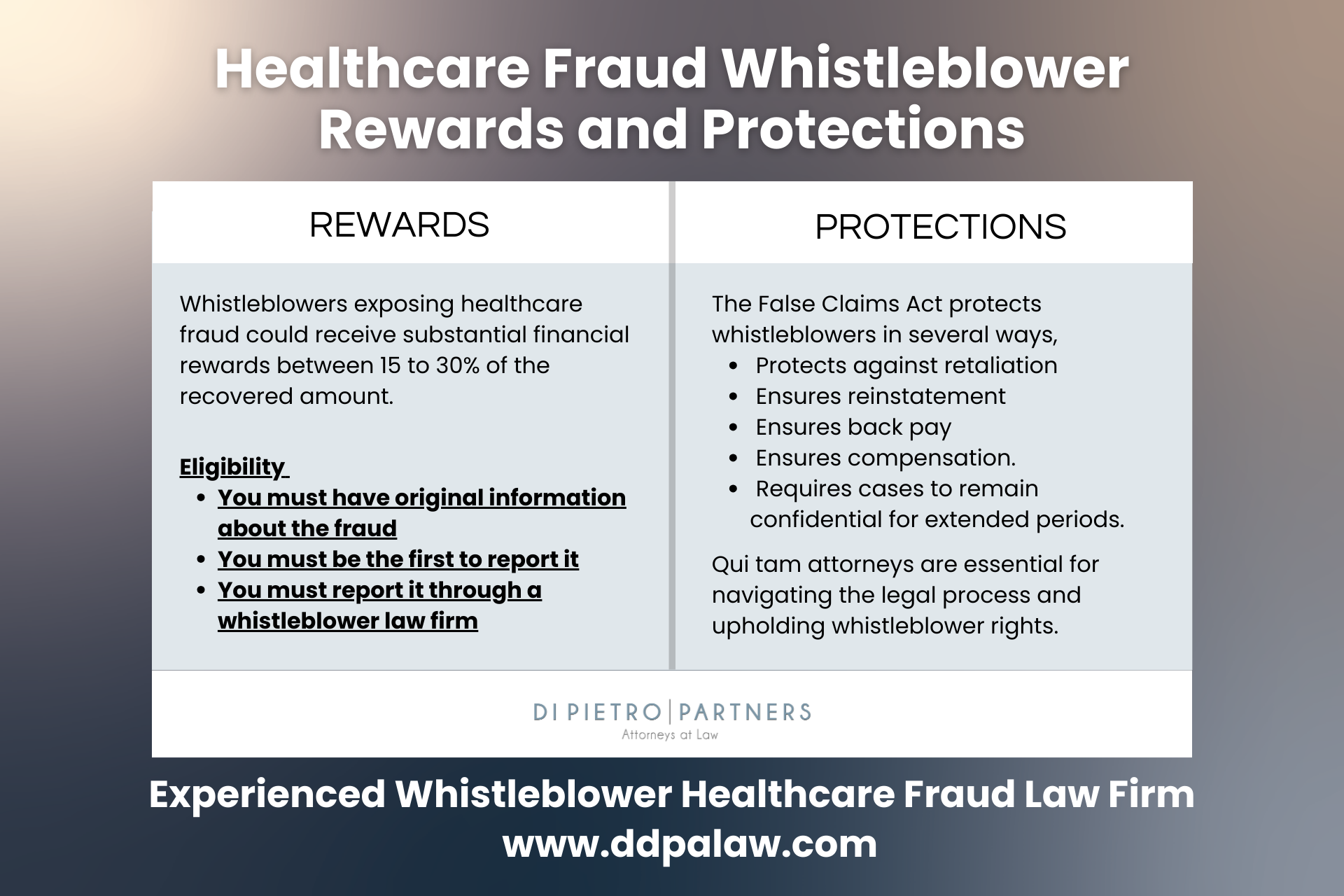
The False Claims Act contains financial incentives designed to encourage whistleblowers to report fraud. If a whistleblower’s information contributes to a successful recovery, the whistleblower may receive a percentage of the government’s recovery.
Generally, whistleblowers may receive between 15% and 25% of the recovery when the government intervenes in the case and between 25% and 30% when the government declines intervention and the whistleblower successfully pursues the matter independently.
False Claims Act Retaliation Protections
The FCA also contains important anti-retaliation provisions. Employees, contractors, and agents may be protected when they investigate fraud, report misconduct, assist government investigations, or otherwise attempt to stop violations of the law.
Workers who experience retaliation may be entitled to remedies including reinstatement, double back pay, special damages, attorney’s fees, and other relief.
HIPAA Whistleblower Protections
Healthcare whistleblowers often encounter sensitive patient information while identifying fraud or misconduct. As a result, whistleblowing activities frequently intersect with the Health Insurance Portability and Accountability Act (HIPAA).
HIPAA generally restricts the disclosure of protected health information (PHI). However, certain exceptions may permit disclosures when an employee reasonably believes an employer has engaged in unlawful conduct, violated professional standards, or created conditions that threaten patient safety or public health.
Healthcare workers should proceed carefully when handling patient records and should seek legal guidance before disclosing information that may be subject to HIPAA protections.
Occupational Safety and Health Act (OSHA)
The Occupational Safety and Health Act (OSHA) provides protections for employees who report workplace health and safety concerns.
In healthcare settings, OSHA protections may apply when workers report:
- unsafe working conditions
- exposure to infectious diseases
- inadequate safety protocols
- dangerous staffing conditions
- workplace hazards that threaten employees or patients
Employers generally may not retaliate against workers for reporting safety concerns or participating in workplace safety investigations.
Affordable Care Act (ACA) Protections
The Affordable Care Act contains whistleblower provisions that may protect employees who report violations involving healthcare coverage requirements, insurance practices, subsidy eligibility, or other ACA-related compliance issues.
Healthcare workers who raise concerns regarding unlawful practices affecting patients, coverage obligations, or regulatory compliance may be entitled to protection from retaliation under certain circumstances.
Sarbanes-Oxley Act (SOX)
The Sarbanes-Oxley Act protects employees of publicly traded companies who report fraud, securities violations, financial misconduct, or other unlawful corporate activities.
For healthcare organizations that are publicly traded, SOX protections may apply when employees disclose:
- financial fraud
- accounting irregularities
- false reporting practices
- shareholder-related misconduct
- improper corporate governance activities
These protections can overlap with healthcare fraud investigations when financial reporting issues involve government reimbursement programs or healthcare operations.
Federal Contractor and Grantee Protections
Many healthcare organizations receive federal funding through contracts, grants, research programs, or government healthcare initiatives. Employees working for these organizations may receive additional protections under federal contractor whistleblower laws.
Federal law may protect workers who report:
- fraud involving government contracts
- misuse of federal grant funds
- gross mismanagement
- violations of laws or regulations
- substantial threats to public health or safety
These protections can be particularly important for employees working with healthcare systems, research institutions, government-funded medical programs, and federal healthcare contractors.
Florida Healthcare Whistleblower Protections
In addition to federal whistleblower laws, healthcare workers in Florida may also be protected under state whistleblower statutes. Depending on the circumstances, a healthcare employee may have rights under both Florida law and federal law when reporting fraud, patient safety concerns, regulatory violations, or other misconduct.
Because healthcare organizations often participate in Medicare, Medicaid, and other government programs, whistleblower cases frequently involve overlapping state and federal protections. Understanding which laws apply can be critical when evaluating a potential retaliation claim.
Florida Whistleblower Act
The Florida Whistleblower Act is designed to protect employees who report certain unlawful activities, violations of laws or regulations, or conduct that creates substantial dangers to public health, safety, or welfare.
The law generally prohibits employers from taking retaliatory action against employees who disclose protected information, object to unlawful conduct, or participate in investigations involving alleged violations.
The specific protections available may depend on whether the employee works for a private employer, a public employer, or a governmental entity.
Protections for Private Healthcare Employees
Private-sector healthcare workers may be protected when they object to, refuse to participate in, or report activities that violate laws, rules, or regulations.
Examples may include reporting:
- Medicare or Medicaid fraud
- illegal billing practices
- kickback arrangements
- falsified medical records
- patient safety violations
- healthcare licensing violations
- HIPAA-related compliance concerns
Private healthcare employees who experience retaliation after making protected disclosures may have the right to pursue legal claims against their employer.
Protections for Public Healthcare Employees
Employees working for public hospitals, government-operated healthcare facilities, public health agencies, and other governmental healthcare organizations may be protected under separate provisions of Florida whistleblower law.
These protections may apply when employees disclose:
- violations of law
- gross mismanagement
- gross waste of public funds
- abuse of authority
- substantial dangers to public health or safety
Public-sector healthcare workers often play an important role in identifying misconduct involving taxpayer-funded healthcare programs and government healthcare operations.
Florida Retaliation Claims
Healthcare workers who experience retaliation after engaging in protected whistleblower activity may have legal remedies available under Florida law. Depending on the circumstances, employees may be entitled to recover lost wages, obtain reinstatement, recover attorney’s fees, and pursue other damages authorized by law.
Because healthcare whistleblower cases often involve both Florida and federal protections, it is important to evaluate all potential claims before taking action.
State and Federal Law Overlap
Many healthcare whistleblower cases involve both Florida and federal law. For example, a healthcare worker who reports Medicare fraud may be protected under the False Claims Act while also having rights under Florida whistleblower statutes. In some situations, healthcare workers may also have claims under the Florida False Claims Act, which allows private individuals to help expose fraud involving state-funded healthcare programs and government funds.
Similarly, reports involving patient safety violations, healthcare fraud, government-funded programs, or regulatory compliance issues may trigger multiple legal protections at the same time.
Because whistleblower laws can be highly complex and deadlines may apply, healthcare workers should consult an experienced whistleblower attorney as soon as possible to evaluate their rights and determine which state and federal protections may apply to their situation.
Telehealth Fraud and Modern Healthcare Fraud Schemes
The healthcare industry has undergone significant changes in recent years, particularly with the rapid expansion of telehealth services. While telemedicine has improved access to care for millions of patients, it has also created new opportunities for fraud, abuse, and improper billing practices.
Federal regulators, the Department of Justice, and healthcare enforcement agencies have increasingly focused on telehealth-related fraud schemes involving Medicare, Medicaid, TRICARE, and private insurance programs. As telehealth continues to evolve, healthcare workers remain on the front lines of identifying fraudulent conduct and protecting both patients and taxpayer-funded healthcare programs.
COVID-19 and the Expansion of Telehealth
Prior to the COVID-19 pandemic, many healthcare services required an in-person patient encounter before providers could bill government healthcare programs. During the public health emergency, federal agencies temporarily expanded telehealth access and relaxed certain restrictions to ensure patients could continue receiving care.
These changes dramatically increased the use of telemedicine throughout the healthcare industry. While many providers used telehealth appropriately, the rapid expansion also created opportunities for bad actors to exploit the system through improper billing and fraudulent reimbursement practices.
As a result, telehealth fraud has become a growing area of concern for government investigators and healthcare whistleblowers alike.
Healthcare fraud is constantly evolving. Today, many investigations focus on telehealth billing, risk adjustment coding, and technology-driven reimbursement systems rather than traditional billing fraud alone.
Improper Telemedicine Billing
One of the most common telehealth fraud schemes involves billing government healthcare programs for services that were never provided or were not eligible for reimbursement.
Examples may include:
- billing for telehealth visits that never occurred
- billing for services that do not qualify for telemedicine reimbursement
- billing longer or more complex visits than were actually performed
- billing under a physician’s name when another individual performed the service
- submitting claims that misrepresent the nature of the patient encounter
Because telehealth services often occur remotely, improper billing practices can be more difficult to detect without information from employees who have direct access to internal records and billing systems.
Risk Adjustment and Medicare Part C Fraud
Another growing area of concern involves Medicare Advantage plans, commonly referred to as Medicare Part C.
Under Medicare Part C, private insurance companies receive payments based in part on the health conditions and risk profiles of enrolled patients. In some cases, healthcare providers or insurers may improperly exaggerate patient diagnoses or aggressively pursue diagnoses that increase reimbursement rates without providing corresponding treatment.
These practices can lead to inflated payments from federal healthcare programs and may form the basis of a False Claims Act investigation when unsupported diagnoses are used to obtain additional government funds.
Healthcare workers involved in coding, compliance, auditing, administration, and patient care are often among the first individuals to identify these types of issues.
Fraudulent Diagnoses and Coding Manipulation
Coding and diagnosis practices play a critical role in healthcare reimbursement. Unfortunately, some organizations manipulate coding practices to maximize payments from government healthcare programs.
Examples may include:
- upcoding patient conditions
- exaggerating diagnoses
- documenting conditions not supported by medical records
- altering billing codes to increase reimbursement
- maintaining inaccurate diagnoses in patient charts
- creating documentation designed to justify higher payments
When coding practices are intentionally manipulated to increase reimbursement, the resulting claims may expose healthcare organizations to significant civil liability.
Multi-State Licensing Violations
The expansion of telehealth has also increased the number of providers treating patients across state lines. While telemedicine offers convenience and broader access to care, providers generally must comply with state licensing requirements where patients are located.
Potential violations may include:
- providing telehealth services without proper state licensure
- billing for services rendered in jurisdictions where the provider is not authorized to practice
- failing to comply with state-specific telehealth regulations
- misrepresenting provider credentials or qualifications
Although licensing violations do not automatically constitute healthcare fraud, they may create compliance issues that expose healthcare organizations to regulatory scrutiny and, in some circumstances, whistleblower claims.
As telehealth continues to reshape the healthcare industry, whistleblowers remain an essential safeguard against fraud, abuse, and misconduct that may otherwise go undetected.
What Should Healthcare Workers Do Before Reporting Fraud?
Healthcare workers who suspect fraud often want to act immediately. However, taking the wrong steps can potentially jeopardize a whistleblower claim, create unnecessary employment issues, or complicate a future government investigation. Before reporting healthcare fraud, employees should carefully evaluate their options and understand their legal rights.
The actions taken in the early stages of a potential whistleblower case can significantly impact the outcome of both the fraud investigation and any related retaliation claims.
Preserve Evidence Carefully
One of the most important steps a potential whistleblower can take is preserving evidence that may support the allegations. Relevant evidence may include billing records, internal reports, emails, compliance documents, patient records, meeting notes, or other materials that demonstrate fraudulent conduct.
However, healthcare workers should be careful not to alter, destroy, fabricate, or improperly remove documents. Maintaining records in their original form can be critical to establishing credibility and supporting future investigations.
In many healthcare fraud cases, whistleblowers possess information that government investigators would not otherwise have access to, making documentation especially valuable.
Avoid Improper Disclosure of PHI
Healthcare whistleblowers must also be mindful of patient privacy laws and the handling of protected health information (PHI).
Although certain disclosures may be permitted when reporting fraud to government authorities or working with legal counsel, healthcare workers should avoid sharing patient information unnecessarily or discussing confidential matters with unauthorized individuals.
Because HIPAA regulations can be complex, employees should seek legal guidance before disclosing medical records or patient information related to a potential whistleblower claim.
Document Timelines and Communications
Creating a clear timeline can help establish when misconduct occurred and when concerns were reported.
Healthcare workers should consider documenting:
- dates of suspected misconduct
- individuals involved
- internal complaints or reports
- meetings with supervisors or compliance personnel
- responses received from management
- instances of potential retaliation
Accurate records can help demonstrate both the underlying misconduct and any adverse actions that occur after concerns are raised.
Consult a Healthcare Whistleblower Attorney Early
Healthcare fraud cases often involve complex federal regulations, employment issues, government investigations, and potential financial rewards under whistleblower laws.
Consulting an experienced healthcare whistleblower attorney early in the process can help employees understand:
- whether they may have a viable claim
- applicable federal and state laws
- whistleblower protections
- reporting procedures
- confidentiality concerns
- potential retaliation risks
An attorney can also help ensure that evidence is preserved properly and that disclosures are made in a legally protected manner.
Understand Internal vs. External Reporting Options
Not every healthcare fraud concern is reported in the same way. Depending on the circumstances, an employee may report misconduct internally through a supervisor, compliance department, ethics hotline, or other reporting mechanism. In other situations, external reporting to government agencies or the filing of a whistleblower action may be appropriate.
The best course of action often depends on the nature of the misconduct, the organization’s response, and the laws involved. Because some whistleblower claims are subject to strict procedural requirements and deadlines, obtaining legal guidance before deciding how to proceed can be an important step toward protecting both the employee’s rights and the integrity of the investigation.
Can Healthcare Whistleblowers Receive Financial Compensation?
Yes. In certain cases, healthcare whistleblowers may be entitled to financial compensation for exposing fraud against the government. Federal whistleblower laws recognize that individuals who come forward often take significant professional and personal risks when reporting misconduct. As a result, some laws provide financial incentives designed to encourage the reporting of healthcare fraud and the recovery of taxpayer funds.
The availability and amount of compensation will depend on the specific law involved, the success of the case, and the whistleblower’s role in helping uncover the fraud.
False Claims Act Whistleblower Rewards
The False Claims Act (FCA) contains one of the most significant whistleblower reward programs in the United States. Under the FCA’s qui tam provisions, private individuals may file lawsuits on behalf of the federal government when they have knowledge of fraud involving Medicare, Medicaid, TRICARE, or other government-funded programs.
If the government recovers funds as a result of the whistleblower’s information, the whistleblower may receive a percentage of that recovery. Because healthcare fraud cases often involve substantial government losses, whistleblower awards can sometimes be significant.
Examples of healthcare fraud that may result in whistleblower rewards include:
- Medicare fraud
- Medicaid fraud
- kickback schemes
- fraudulent billing practices
- telehealth fraud
- unnecessary medical procedures
- falsified diagnoses
- pharmaceutical fraud
How Whistleblower Recoveries Are Calculated
Whistleblower awards are generally based on the amount recovered by the government through settlements or judgments.
Healthcare fraud cases may involve:
- repayment of improperly obtained funds
- civil penalties
- statutory damages
- other financial recoveries
The larger the government’s recovery, the larger the potential whistleblower award may be. Because many healthcare fraud investigations involve nationwide billing practices, hospital systems, insurance organizations, or large healthcare providers, recoveries can sometimes reach millions of dollars.
Government Intervention and Recovery Percentages
The percentage awarded to a whistleblower often depends on whether the Department of Justice intervenes in the case.
Generally:
- If the government intervenes and takes over the case, the whistleblower may receive between 15% and 25% of the government’s recovery.
- If the government declines intervention and the whistleblower successfully pursues the case independently, the award may increase to 25% to 30% of the recovery.
In determining the final award, courts and government agencies may consider factors such as the value of the information provided, the whistleblower’s contribution to the investigation, and the overall success of the case.
Retaliation-Related Compensation
In addition to whistleblower rewards, healthcare workers who experience retaliation may have separate claims for compensation.
Depending on the circumstances, a successful retaliation claim may allow recovery of:
- lost wages and benefits
- reinstatement to employment
- future lost earnings
- emotional distress damages
- attorney’s fees and costs
- other damages authorized by law
Importantly, a healthcare worker may have both a whistleblower reward claim and a retaliation claim arising from the same underlying misconduct.
Because whistleblower rewards and retaliation claims involve complex legal and procedural requirements, healthcare workers should consult an experienced whistleblower attorney before taking action. An attorney can evaluate potential compensation opportunities, explain available protections, and help maximize the likelihood of a successful outcome.
Related Resource: Learn more about Healthcare Fraud Whistleblower Rewards and how whistleblower compensation is calculated in federal healthcare fraud cases.
Common Examples of Healthcare Fraud
Healthcare fraud can take many forms and may occur in hospitals, physician practices, nursing homes, pharmacies, laboratories, telehealth companies, insurance organizations, and other healthcare settings. While every case is unique, certain schemes appear repeatedly in whistleblower investigations and False Claims Act cases.
Healthcare workers are often the first individuals to recognize these schemes because they have direct access to billing records, patient information, compliance reports, and internal operations. The following examples represent some of the most common types of healthcare fraud reported by healthcare workers, compliance professionals, billing personnel, and other industry insiders.
Medicare Part C Fraud
Medicare Part C, also known as Medicare Advantage, has become a major focus of healthcare fraud investigations. Common allegations involve improper risk adjustment coding, unsupported diagnoses, and efforts to increase reimbursement payments from federal healthcare programs. Healthcare workers involved in coding, compliance, auditing, and administration are often among the first to identify these issues.
Telehealth Fraud
Telehealth fraud remains one of the fastest-growing areas of healthcare fraud enforcement. Common allegations include billing for services not provided, improper telemedicine billing, fraudulent diagnoses, and licensing-related violations. As discussed above, federal regulators continue to scrutinize telehealth reimbursement practices and telemedicine-related fraud schemes.
Hospice Fraud
Hospice programs provide care for patients with terminal illnesses who meet specific eligibility requirements. Fraud may occur when providers improperly enroll patients who do not qualify for hospice services or continue billing after patients no longer meet eligibility criteria.
Examples may include:
- enrolling non-terminal patients
- falsifying patient records
- billing for services not provided
- retaining patients in hospice unnecessarily
- submitting false certifications of terminal illness
These schemes can result in significant financial losses to Medicare and may negatively impact patient care.
Pharmaceutical Fraud
Pharmaceutical fraud may involve unlawful conduct by drug manufacturers, distributors, pharmacies, or healthcare providers.
Examples may include:
- illegal kickbacks
- off-label marketing violations
- false pricing information
- prescription fraud
- overbilling government healthcare programs
- providing improper financial incentives to healthcare providers
Whistleblowers frequently play a key role in exposing pharmaceutical fraud schemes that affect federal healthcare programs.
Durable Medical Equipment Fraud
Durable Medical Equipment (DME) fraud involves improper billing related to equipment such as wheelchairs, braces, oxygen supplies, prosthetics, and other medical devices.
Common examples include:
- billing for equipment never delivered
- billing for medically unnecessary equipment
- duplicate billing
- falsifying patient need
- providing lower-quality products than billed
DME fraud has long been a major focus of Medicare fraud investigations.
Nursing Home Fraud
Residents of nursing homes and long-term care facilities are particularly vulnerable to fraud and abuse.
Examples of nursing home fraud may include:
- billing for services not provided
- inadequate staffing despite reimbursement claims
- falsified care records
- improper medication practices
- neglect or abuse concealed through inaccurate documentation
- fraudulent Medicare or Medicaid billing
Healthcare workers employed by nursing facilities are often among the first individuals to identify these issues.
Laboratory Billing Fraud
Laboratories play an important role in diagnosing and monitoring patient conditions. However, improper billing practices can result in substantial losses to government healthcare programs.
Examples may include:
- billing for tests never performed
- unnecessary diagnostic testing
- improper coding practices
- duplicate billing
- altering physician orders
- adding unauthorized testing services
Laboratory fraud cases frequently involve large numbers of patients and substantial reimbursement claims.
Electronic Health Record Manipulation
Electronic Health Records (EHRs) have become a central part of modern healthcare delivery and billing. Unfortunately, EHR systems may also be used to facilitate fraudulent practices.
Examples may include:
- altering patient records to justify billing
- copying and pasting inaccurate information
- creating documentation after services were billed
- maintaining unsupported diagnoses
- manipulating records to increase reimbursement
Because healthcare reimbursement often depends on documentation contained within electronic health records, inaccurate or intentionally falsified records can create significant liability under the False Claims Act and other healthcare fraud laws.
These examples represent only a portion of the healthcare fraud schemes investigated under federal and state whistleblower laws. As healthcare reimbursement systems become increasingly complex, fraud schemes continue to evolve. Healthcare workers who identify suspicious billing practices, patient safety concerns, regulatory violations, or other misconduct should consider seeking legal guidance to better understand their rights and reporting options.
Frequently Asked Questions
Can a Nurse Be a Healthcare Whistleblower?
Yes. Nurses are among the most common healthcare whistleblowers because they often have firsthand knowledge of patient care, medical documentation, billing practices, staffing issues, and regulatory compliance concerns. A nurse may qualify for whistleblower protections when reporting healthcare fraud, patient safety violations, falsified records, Medicare or Medicaid fraud, or other unlawful conduct. Depending on the circumstances, both federal and state whistleblower laws may provide protection against retaliation.
Can Healthcare Workers Report Fraud Anonymously?
In some situations, healthcare workers may be able to report suspected fraud anonymously. However, anonymity is not always guaranteed, particularly if an investigation progresses or legal proceedings become necessary. Because whistleblower claims often involve strategic decisions regarding confidentiality, healthcare workers should consult an experienced whistleblower attorney before reporting misconduct.
Can I Be Fired for Reporting Healthcare Fraud?
Federal and state whistleblower laws generally prohibit employers from retaliating against employees who report healthcare fraud, patient safety concerns, or other unlawful conduct in good faith. While retaliation can still occur, employees may have legal remedies available if they are terminated, demoted, harassed, or otherwise subjected to adverse employment actions because of protected whistleblower activity.
How Long Do Whistleblower Cases Take?
Healthcare whistleblower cases can vary significantly in length depending on the complexity of the allegations, the amount of evidence involved, and whether government agencies choose to investigate. Some cases may be resolved within months, while others can take several years. False Claims Act cases, in particular, often remain under seal while the government evaluates the allegations and determines whether to intervene.
What Evidence Is Helpful in a Whistleblower Case?
Helpful evidence may include billing records, emails, compliance reports, internal communications, meeting notes, audit findings, financial records, and other documentation that supports allegations of fraud or misconduct. Healthcare workers should avoid improperly obtaining records or violating patient privacy laws. Before collecting or disclosing information, whistleblowers should seek legal guidance to ensure evidence is preserved and handled appropriately.
Do Healthcare Whistleblowers Receive Rewards?
In certain cases, yes. Under the False Claims Act, whistleblowers who help the government recover funds obtained through fraud may be entitled to receive a percentage of the recovery. The amount of a potential reward depends on several factors, including the success of the case, the government’s involvement, and the value of the information provided by the whistleblower.
What Is a Qui Tam Lawsuit?
A qui tam lawsuit is a legal action filed by a private individual on behalf of the United States government under the False Claims Act. The person bringing the claim, known as a relator, alleges that a company or individual submitted false claims for payment to the government. If the case is successful and the government recovers funds, the whistleblower may be eligible to receive a portion of the recovery.
Contact a Healthcare Whistleblower Attorney
Healthcare whistleblower cases often involve complex federal regulations, government investigations, retaliation concerns, and highly technical medical and billing issues. Before reporting healthcare fraud, it is important to understand your rights and legal options.
Di Pietro Partners represents healthcare whistleblowers nationwide in matters involving Medicare fraud, Medicaid fraud, False Claims Act violations, telehealth fraud, unlawful billing practices, and healthcare retaliation claims. Led by nationally recognized trial attorney David Di Pietro, former Chairman of Broward Health, our firm offers a unique combination of legal and medical insight.
In addition to our healthcare litigation experience, our team includes Dr. Tiffany Di Pietro, a licensed Florida physician and quadruple board-certified cardiologist who serves as the firm’s Medical Advisor, helping evaluate complex healthcare and medical issues that often arise in whistleblower cases.
Free Confidential Consultation
Discuss your situation confidentially with an experienced healthcare whistleblower attorney.
Nationwide Representation
We represent whistleblowers across the United States in complex healthcare fraud and False Claims Act matters.
Contingency Fee Representation
You pay no attorney’s fees unless we recover compensation on your behalf.
Speak With Di Pietro Partners Today
If you have information about healthcare fraud or believe you have been retaliated against for reporting misconduct, contact Di Pietro Partners to discuss your potential whistleblower claim.
