

When a patient enters an emergency room they give their complete trust to doctors and medical care providers, relying on them to properly diagnose and care for them. Unfortunately, there are times when this is not the case and members of the emergency room staff may act negligently, resulting in serious patient injuries or even death. These situations are referred to as emergency room errors, which fall under the umbrella of medical malpractice.
If you are a victim of this type of medical malpractice and are in unnecessarily increased pain and suffering as a result, you have options to seek the justice you deserve. An experienced emergency room malpractice attorney will fight for your rights and ensure you are fairly compensated for your healthcare provider’s negligence. A skilled lawyer can help you investigate your healthcare provider’s actions and lay the groundwork for a solid case based on the information uncovered and relevant laws.
Please note, there’s a limited amount of time to file a claim after the error occurs so it’s important to seek legal advice as soon as possible.
Differential Diagnosis
Due to the time sensitive nature of emergency rooms, the procedures and techniques used can be considerably different from those used in traditional medical settings. In this environment, doctors frequently use what is called a differential diagnosis to pinpoint the conditions that may be causing the patient’s ailments.
This technique involves doctors creating a list of potential conditions that could be responsible for their patient’s symptoms, and then narrowing down the list beginning with the worst possible diagnosis. Doctors narrow this down by employing certain types of diagnostic tests and assessments to determine if a patient has any conditions on the differential diagnosis list.
Types of Emergency Room Errors
Medical malpractice in emergency rooms generally happens in a couple ways. One of the most common is the misreading of a patient’s diagnostic studies, which can result in the patient not receiving the correct treatment for the illness they actually have. Another common type of medical malpractice in emergency rooms is the doctor not taking a patient’s situation seriously enough and moving the patient to an area of the hospital that is not properly equipped to care for them. Situations like this can cause a patient’s health to decline and worsen their symptoms. In extreme cases, it can result in a patient’s death.
Filing Emergency Room Claims
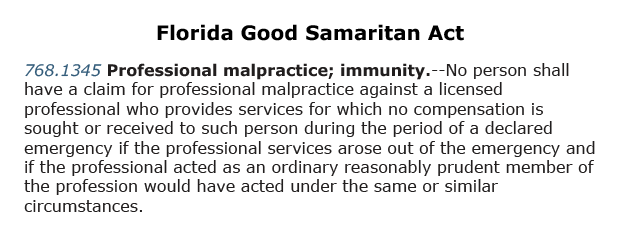 Generally speaking, emergency room doctors are protected from liability due to Florida’s Good Samaritan Law. According to this law,
“Professional malpractice; immunity.—No person shall have a claim for professional malpractice against a licensed professional who provides services for which no compensation is sought or received to such person during the period of a declared emergency if the professional services arose out of the emergency and if the professional acted as an ordinary reasonably prudent member of the profession would have acted under the same or similar circumstances.”
There is an exception which allows patients to bring suit against their doctors for negligence. This exception specifically states that if a doctor does not adhere to the standard of care owed to their patients and acts with reckless disregard, their patient can file a suit against them if there are resulting injuries or wrongful death. In addition, the circumstances surrounding this could lead a jury to award punitive damages to the patient. This serves to punish serious acts of negligence and act as a strong deterrence to any future instances of misconduct by the doctor.
Patients can also file lawsuits for medical malpractice against nurses, following the same process as filing suit against a doctor. Some nurses will have their own individual insurance policies, and others may have insurance through their staffing companies or the hospital itself. The only exception is that nurses who work for government agencies are immune from liability and cannot be sued directly.
Emergency Room Errors Statute of Limitations
Florida’s series of complex Medical Malpractice Laws can be difficult to navigate and understand. The Florida Malpractice Act places the burden of proof upon the plaintiff to prove a medical professional was in fact negligent. In order to do this, another medical professional from the same field will be needed to testify for you. Additionally, causation must be proved, meaning that there must be proof that the medical professional’s actions or failure to act was the cause for your injuries.
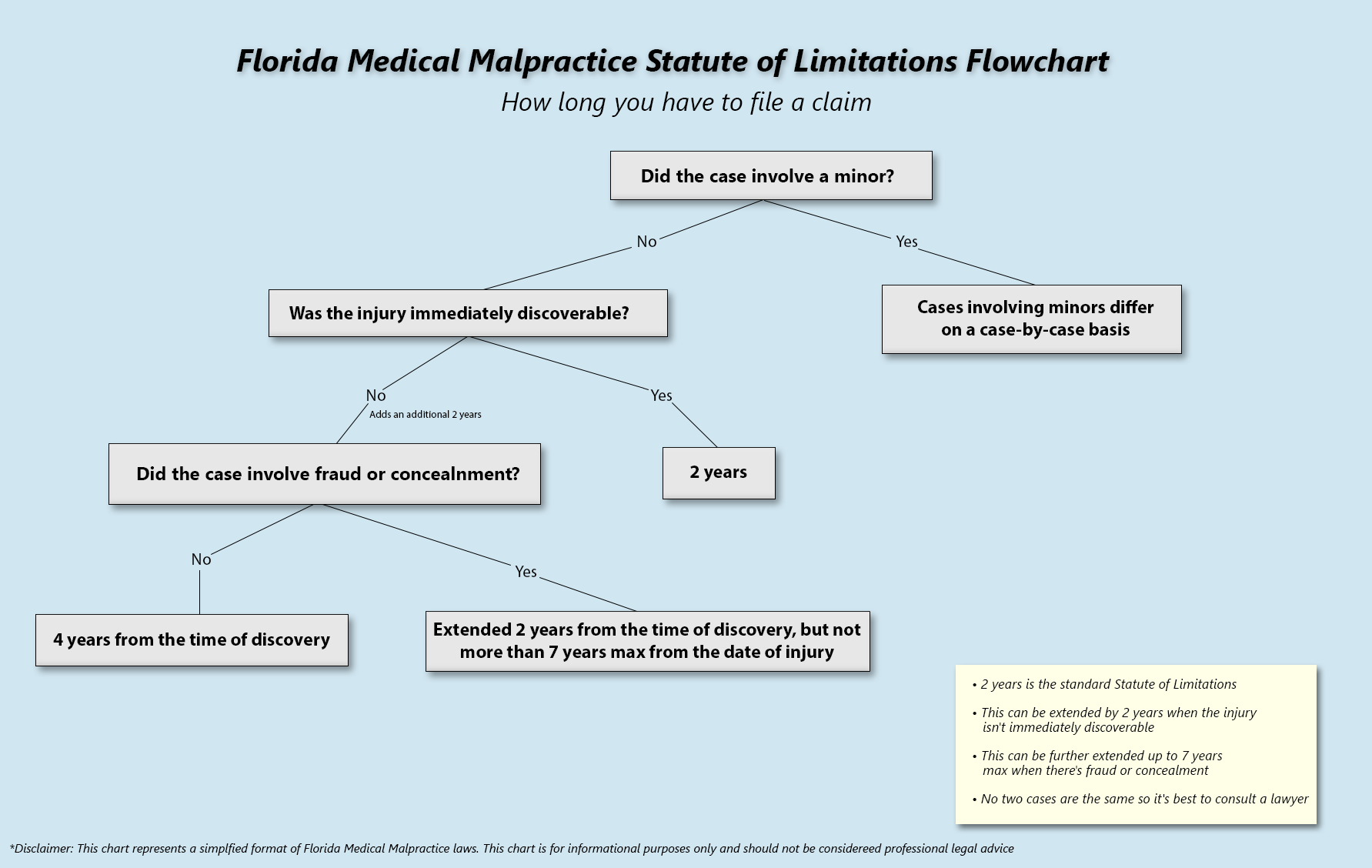
On top of this, the State of Florida has a statute of limitations on malpractice cases. According to the medical malpractice statute in The Florida Legislature: (2018).
“An action for medical malpractice shall be commenced within 2 years from the time the incident giving rise to the action occurred or within 2 years from the time the incident is discovered, or should have been discovered with the exercise of due diligence; however, in no event shall the action be commenced later than 4 years from the date of the incident or occurrence out of which the cause of action accrued, except that this 4-year period shall not bar an action brought on behalf of a minor on or before the child’s eighth birthday…”
In other words, in many cases, there is a 2-4 year statute of limitations on malpractice claims in Florida with several exceptions (i.e. a minor child was involved). Furthermore, cases involving fraud, intentional misrepresentation, or concealment carry a 7 year maximum limit on filing a claim. As a result, it’s imperative to have your case reviewed by our legal and medical professionals as soon as possible.
Because of this limited time window, it is absolutely critical that you hire an experienced medical malpractice attorney to investigate your case as soon as possible.
Emergency Room Malpractice Attorney
The law firm of Di Pietro Partners represents clients who have been injured as a result of medical negligence anywhere in the State of Florida. Our lawyers have the knowledge and experience to represent your interests in court and get you the settlement you deserve.
If you or a loved one have been injured as a result of emergency room malpractice or negligence on the behalf of a medical professional, contact our law firm for a free and confidential case evaluation.