
Georgia Whistleblower Healthcare Fraud Attorneys
Healthcare fraud in Georgia encompasses illegal practices that exploit Medicare, Georgia Medicaid, and other government-funded healthcare programs for financial gain. Georgia has a large and diverse healthcare system that includes hospitals, medical practices, pharmacies, laboratories, nursing facilities, home health agencies, behavioral health providers, and managed care organizations.
The size and complexity of Georgia’s healthcare system create opportunities for false billing, kickback arrangements, medically unnecessary services, pharmaceutical fraud, durable medical equipment schemes, and other practices that divert healthcare funds away from patients and taxpayers.
The national healthcare fraud lawyers at Di Pietro Partners are committed to representing whistleblowers in Georgia. We understand the courage it takes to expose misconduct within a hospital, medical practice, pharmacy, nursing facility, healthcare company, or other organization.
Our attorneys handle healthcare whistleblower cases on a contingency fee basis, meaning you will not pay legal fees unless we recover funds on your behalf. This allows whistleblowers to pursue accountability without taking on the financial risk of litigation.
If you suspect healthcare fraud in Georgia, contact our law firm for a free and confidential consultation.
Table of Contents
Georgia Healthcare Fraud Overview
Types of Healthcare Fraud
Georgia Healthcare Fraud by Area
Reporting Georgia Healthcare Fraud
Medicare Fraud in Georgia
Medicaid Fraud in Georgia
The Georgia False Medicaid Claims Act
Federal Healthcare Fraud Laws
Georgia Whistleblower Rewards
Talk to a Georgia Healthcare Fraud Lawyer
Healthcare Fraud in Georgia
Healthcare fraud in Georgia refers to schemes that improperly obtain money from Medicare, Medicaid, or other government healthcare programs through false claims, fraudulent billing, illegal financial arrangements, or deceptive healthcare practices.
Georgia Medicaid is jointly funded by the state and federal governments and provides healthcare coverage to eligible low-income families, children, seniors, people with disabilities, and other qualifying residents. Because billions of dollars pass through Georgia’s healthcare system, effective oversight is essential to ensuring that public funds are used for legitimate patient care.
Fraud can occur across many areas of the healthcare industry, including hospitals, physician practices, laboratories, pharmacies, home health agencies, behavioral health providers, durable medical equipment suppliers, nursing facilities, and Medicaid waiver programs.
Whistleblowers are often critical to identifying healthcare fraud because employees and industry insiders may have firsthand knowledge of billing practices, patient records, internal communications, or financial arrangements that government investigators cannot otherwise see.
Types of Healthcare Fraud in Georgia
Healthcare fraud can take many forms throughout Georgia. Common examples include:
Healthcare Fraud – A broad category covering fraudulent schemes involving government healthcare programs, insurers, medical providers, and healthcare contractors.
Medicare Fraud – Knowingly submitting false claims, records, or statements to improperly obtain Medicare payments.
Medicaid Fraud – Fraud involving Georgia Medicaid, including billing for services never provided, falsifying patient information, or improperly obtaining reimbursement.
Pharmaceutical Fraud – Illegal conduct involving prescription drugs, including kickbacks, improper marketing, false pricing, misbranding, or billing for medications that were never dispensed.
Durable Medical Equipment Fraud – Fraudulent billing involving wheelchairs, braces, oxygen supplies, diabetic equipment, and other medical equipment covered by Medicare or Medicaid.
Medical Billing Fraud – Submitting claims for appointments, treatments, tests, or procedures that patients never received.
Upcoding – Billing for a more expensive procedure or level of service than was actually provided.
Unbundling – Separately billing services that should have been billed together in order to increase reimbursement.
Medically Unnecessary Services – Ordering or performing treatments, tests, prescriptions, or procedures that are not medically necessary primarily to generate additional reimbursement.
Kickback Schemes – Offering, paying, soliciting, or receiving improper compensation in exchange for patient referrals or healthcare business involving federally funded programs.
Home Health and Personal Care Fraud – Billing for care that was never provided, exaggerating hours worked, or submitting false timesheets for Medicaid-funded services.
False Documentation – Creating or altering medical records, treatment notes, patient files, prescriptions, or timesheets to support false healthcare claims.
Laboratory and Genetic Testing Fraud – Billing for unnecessary or nonexistent laboratory tests, falsifying physician orders, or improperly using patient or provider information to support claims.
Georgia Healthcare Fraud by Area
Healthcare fraud can occur anywhere in Georgia, although larger metropolitan areas and regional healthcare centers generally process greater volumes of Medicare and Medicaid claims.
Atlanta – As Georgia’s largest metropolitan area, Atlanta contains a significant concentration of hospitals, medical practices, laboratories, pharmacies, home health providers, and government healthcare beneficiaries.
Augusta – Augusta is a major regional healthcare center with hospitals, specialty providers, behavioral health practices, and other healthcare organizations serving eastern Georgia.
Savannah – Savannah’s healthcare network serves a large population throughout coastal Georgia and includes hospitals, medical practices, nursing facilities, and home health providers.
Macon – Macon serves as an important healthcare hub for central Georgia, with medical facilities and providers serving patients from surrounding communities.
Columbus – Columbus has a substantial healthcare infrastructure serving western Georgia and neighboring communities.
Athens-Clarke County – Athens includes hospitals, medical practices, university-affiliated healthcare services, and providers participating in Medicare and Medicaid.
Gwinnett County – One of Georgia’s most populous counties, Gwinnett contains a large and growing network of physicians, healthcare businesses, laboratories, and home health providers.
Cobb County – Cobb County includes numerous hospitals, specialty practices, laboratories, and other healthcare providers serving the Atlanta metropolitan area.
Recent Georgia Medicaid enforcement actions have involved providers and individuals in several regions of the state, including Athens-Clarke, Gwinnett, Houston, Richmond, Cobb, and DeKalb counties, demonstrating that healthcare fraud enforcement extends well beyond metropolitan Atlanta.
Reporting Georgia Healthcare Fraud
If you suspect healthcare fraud in Georgia, taking the proper steps can help preserve important information while protecting your legal rights.
Gather Relevant Information: Preserve billing records, emails, reports, policies, or other materials that you are legally authorized to access. Avoid accessing confidential systems or removing records outside the scope of your authorization.
Document Your Observations: Create a detailed timeline identifying the suspected conduct, individuals involved, relevant dates, billing practices, and how government healthcare funds may have been affected.
Consult a Healthcare Fraud Attorney: An experienced whistleblower attorney can evaluate the suspected misconduct, determine whether it may support a False Claims Act case, and explain how to proceed without compromising a potential investigation.
Report Georgia Medicaid Fraud: Georgia’s Attorney General operates the Medicaid Fraud and Patient Protection Division, which investigates and prosecutes fraud involving the Georgia Medicaid program. The division also investigates certain cases involving abuse, neglect, and exploitation of vulnerable patients.
Report Federal Healthcare Fraud: Fraud involving Medicare or other federal healthcare programs may also be reported to the U.S. Department of Health and Human Services Office of Inspector General.
Understand Whistleblower Protections: Federal law and Georgia’s False Medicaid Claims Act provide protections for qualifying whistleblowers who face retaliation because of lawful efforts to stop or expose false claims.
Because qui tam lawsuits are subject to specific filing and confidentiality requirements, potential whistleblowers should consider speaking with an attorney before confronting the suspected wrongdoer or publicly disclosing allegations.
Georgia Medicare Fraud
Medicare provides healthcare coverage to elderly individuals and certain people with disabilities throughout Georgia. The program reimburses hospitals, physicians, laboratories, pharmacies, home health agencies, hospices, durable medical equipment suppliers, and numerous other healthcare providers.
The enormous volume and complexity of Medicare billing can make fraudulent claims difficult for regulators to identify without information from employees and healthcare insiders.
Common Medicare fraud schemes in Georgia may include:
- Billing for services that were never provided
- Falsifying diagnoses or medical records
- Upcoding procedures and office visits
- Billing for medically unnecessary treatment
- Illegal kickbacks for patient referrals
- Durable medical equipment fraud
- Laboratory and genetic testing schemes
- Home health and hospice fraud
- Fraudulent telemedicine arrangements
- Billing under another provider’s credentials
Whistleblowers may possess the internal records, communications, billing information, and firsthand knowledge necessary to demonstrate how fraudulent Medicare claims were generated.
The Medicare fraud lawyers at Di Pietro Partners represent Georgia whistleblowers who come forward with information about false claims submitted to federal healthcare programs.
Georgia Medicaid Fraud
Georgia Medicaid provides healthcare coverage to qualifying residents and is jointly funded by the federal government and the State of Georgia. Because the program reimburses a wide variety of healthcare services, Medicaid fraud can arise in physician practices, hospitals, pharmacies, behavioral health providers, home care companies, laboratories, nursing facilities, and other healthcare organizations.
Examples of Georgia Medicaid fraud may include:
- Billing for services never provided
- Submitting false timesheets
- Billing for nonexistent or ineligible patients
- Falsifying provider or patient information
- Billing for medically unnecessary services
- Using another provider’s identity or credentials
- Paying or receiving improper referral fees
- Durable medical equipment fraud
- Laboratory and genetic testing fraud
- Home and community-based services fraud
- Misrepresenting the level or duration of patient care
Georgia has recently pursued Medicaid cases involving false claims for personal care services, durable medical equipment, behavioral healthcare, wound care, psychotherapy, and genetic testing. In June 2026, the Georgia Attorney General also announced participation in the National Health Care Fraud Takedown, including a federal indictment alleging more than $4 million in false Georgia Medicaid billings.
The Georgia Medicaid fraud lawyers at Di Pietro Partners help whistleblowers evaluate suspected misconduct and determine whether it may support a claim under federal or Georgia false claims laws.
The Georgia False Medicaid Claims Act
Georgia has its own whistleblower statute specifically addressing fraud against the Georgia Medicaid program. Known as the Georgia False Medicaid Claims Act, it is codified at O.C.G.A. §§ 49-4-168 through 49-4-168.6.
The law imposes liability on individuals and organizations that knowingly submit false or fraudulent claims to Georgia Medicaid, use false records or statements material to those claims, conspire to violate the statute, or improperly retain money owed to the Medicaid program.
Importantly for whistleblowers, the statute permits a private individual to bring a civil action in the name of the State of Georgia. The Georgia Attorney General then has an opportunity to investigate the allegations and determine whether the state will intervene and proceed with the case.
The Georgia False Medicaid Claims Act also protects employees, contractors, and agents who suffer retaliation because of lawful efforts to expose or stop violations. Available remedies may include reinstatement, double back pay, interest, compensation for certain damages, litigation costs, and reasonable attorney’s fees.
Unlike a general state False Claims Act covering every category of government spending, Georgia’s statute is specifically focused on claims involving the Georgia Medicaid program.
Federal Healthcare Fraud Laws
Several federal statutes may apply when healthcare providers or businesses submit fraudulent claims or engage in unlawful financial arrangements.
False Claims Act – The federal False Claims Act prohibits knowingly submitting false claims for government payment or using false records and statements material to those claims. It allows qualifying private whistleblowers to bring qui tam lawsuits on behalf of the United States.
Anti-Kickback Statute – The federal Anti-Kickback Statute generally prohibits knowingly and willfully offering, paying, soliciting, or receiving remuneration to induce or reward referrals involving federally funded healthcare programs.
Stark Law – The Physician Self-Referral Law, commonly known as the Stark Law, restricts certain physician referrals involving designated health services payable by Medicare or Medicaid when the physician or an immediate family member has a prohibited financial relationship with the entity receiving the referral.
Health Care Fraud Statute – Federal law makes it a criminal offense to knowingly and willfully execute a scheme designed to defraud a healthcare benefit program or obtain healthcare funds through false or fraudulent representations.
Civil Monetary Penalties Law – The Civil Monetary Penalties Law provides for administrative penalties relating to various forms of healthcare misconduct, including certain false claims and prohibited financial arrangements.
Depending on the circumstances, healthcare fraud may result in civil penalties, treble damages, exclusion from federal healthcare programs, professional disciplinary consequences, restitution, or criminal prosecution.
Georgia Whistleblower Rewards
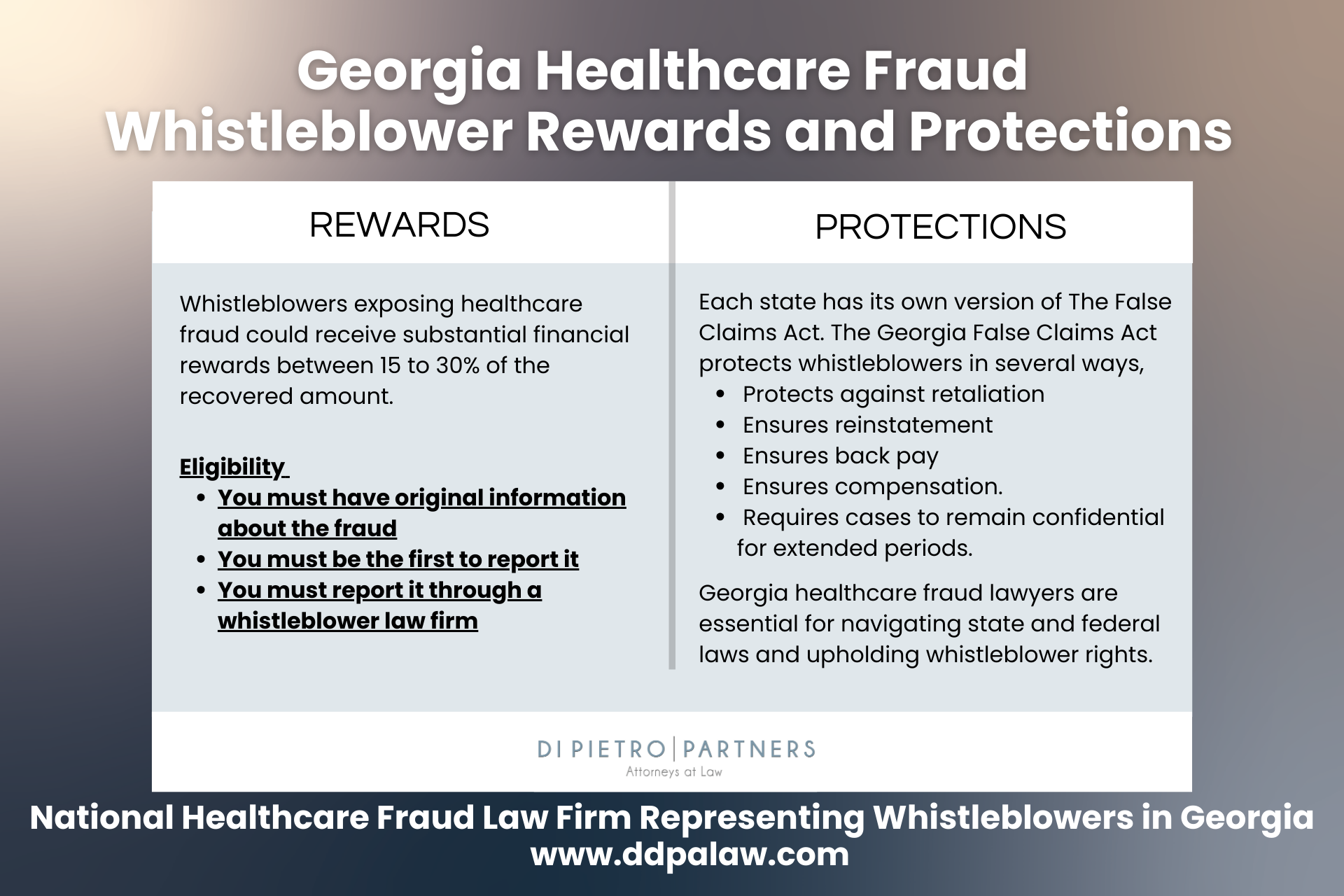
Whistleblowers who successfully expose fraud involving Medicare, Georgia Medicaid, or another government healthcare program may be entitled to receive a percentage of the government’s recovery.
Under the federal False Claims Act, qualifying whistleblowers generally may receive between 15% and 30% of the recovery, depending largely on whether the government intervenes and the circumstances of the case.
Georgia’s False Medicaid Claims Act provides similar financial incentives for Medicaid whistleblowers. When the Georgia Attorney General proceeds with a qualifying qui tam action, a whistleblower generally may receive between 15% and 25% of the recovery. If the Attorney General does not proceed and the whistleblower successfully pursues the action, the award generally ranges from 25% to 30%.
Whistleblowers may therefore play a crucial role in:
- Stopping ongoing fraudulent billing
- Recovering taxpayer funds
- Exposing illegal kickback arrangements
- Protecting patients from unnecessary treatment
- Identifying false medical documentation
- Protecting the integrity of Medicare and Georgia Medicaid
Healthcare whistleblower cases involve important procedural and confidentiality requirements. Speaking publicly about suspected fraud or alerting the organization involved before obtaining legal guidance can potentially affect an investigation or claim.
At Di Pietro Partners, we help Georgia healthcare whistleblowers understand their options, protect their rights, and pursue appropriate claims confidentially.
Talk to a Georgia Healthcare Fraud Lawyer
Healthcare fraud diverts money from programs intended to provide essential care to seniors, people with disabilities, low-income families, children, and other patients throughout Georgia.
Employees and healthcare industry insiders are often uniquely positioned to identify false billing, kickbacks, unnecessary procedures, fabricated medical records, and other fraudulent practices before regulators become aware of them.
At Di Pietro Partners, our national healthcare fraud attorneys represent whistleblowers in Georgia matters involving Medicare fraud, Medicaid fraud, pharmaceutical fraud, billing fraud, durable medical equipment schemes, laboratory fraud, kickbacks, home health fraud, and other false claims.
We handle healthcare whistleblower cases on a contingency fee basis, meaning you pay no legal fees unless we recover funds on your behalf.
If you suspect healthcare fraud in Georgia, contact Di Pietro Partners for a free and confidential consultation.