

The False Claims Act (FCA) exists to prevent fraud and protect taxpayers. Numerous state and federal laws work together to combat abuse within the United States healthcare system. Despite these laws, some individuals and organizations continue to engage in fraudulent activities for financial gain. Fortunately, courageous individuals step forward to expose healthcare fraud. These whistleblowers play a critical role in protecting public healthcare programs. If you suspect healthcare fraud in Georgia or elsewhere, contact an experienced healthcare fraud attorney to ensure your rights are protected.
In Georgia, healthcare whistleblowers should understand that different false claims laws may apply depending on which government program was allegedly defrauded. Medicaid fraud is specifically addressed by the Georgia False Medicaid Claims Act, while other false claims involving state or local government funds may fall under the Georgia Taxpayer Protection False Claims Act.
Georgia False Claims Act Laws
Fraudulent healthcare claims are governed by both federal and state laws:
Federal Law
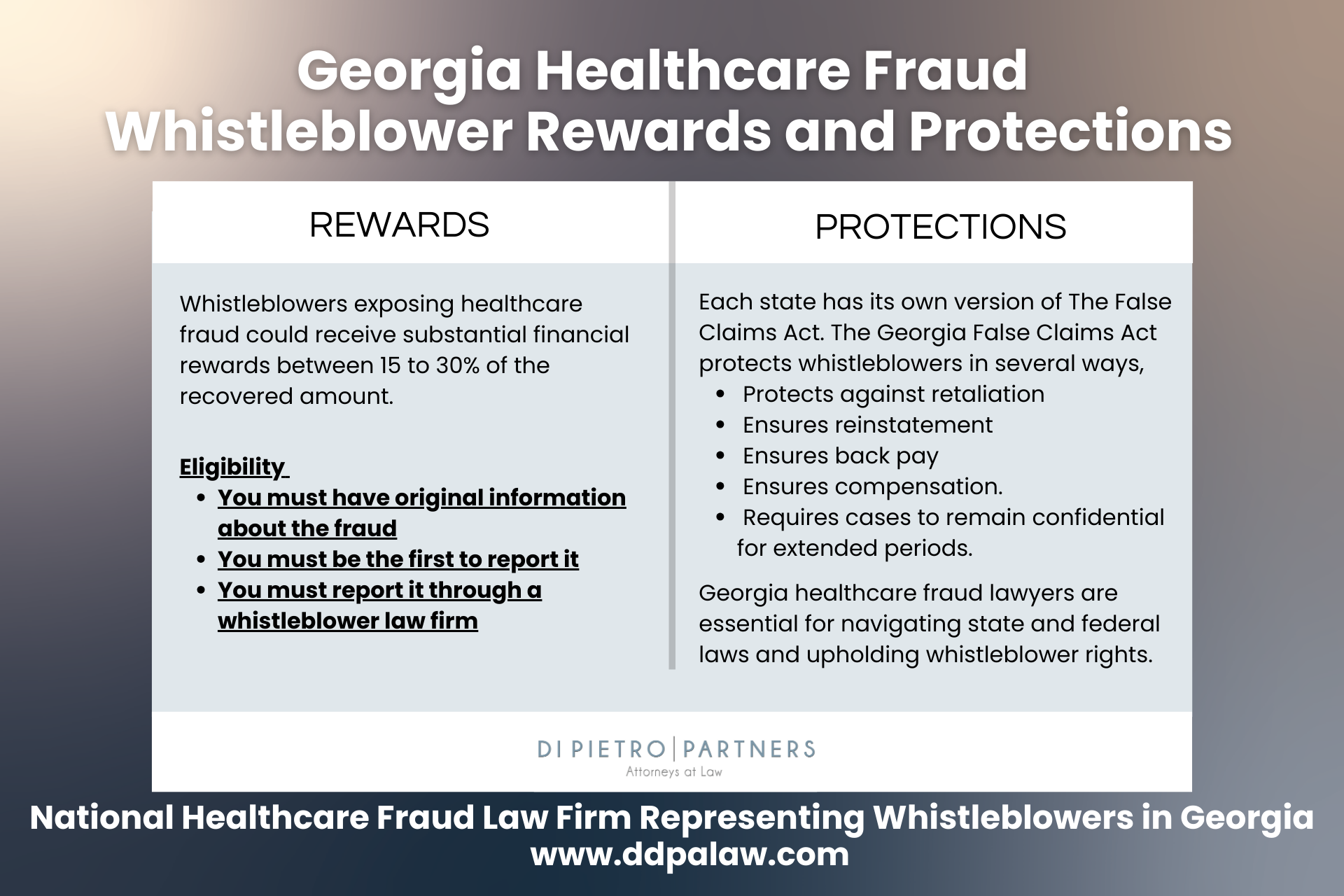
The U.S. False Claims Act (31 U.S.C. §§ 3729–3733) addresses fraud committed against federally funded healthcare programs like Medicare and Medicaid. Under the FCA, private individuals who know about a false claim can file a civil lawsuit on behalf of the federal government through a process known as qui tam. Whistleblowers may receive a percentage of the recovered funds. If the government joins the case, the whistleblower’s reward may be slightly lower but still substantial. Due to the complexity of these cases, consulting an experienced healthcare fraud attorney is essential.
Georgia State Law
The Georgia False Medicaid Claims Act (GFMCA) (O.C.G.A. §§ 49-4-168 to 49-4-168.6) empowers the State of Georgia to pursue healthcare providers or entities that knowingly submit false claims for Medicaid reimbursement. Similar to the federal FCA, violators face civil penalties and significant fines for each false claim. Georgia’s law also includes strong whistleblower protections and offers financial incentives for individuals who report fraud. Your attorney will explain the potential rewards and legal protections available under Georgia law. The law also permits private individuals, known as relators, to bring qualifying qui tam actions on behalf of the State of Georgia involving false or fraudulent claims submitted to the Georgia Medicaid program
Georgia also has a separate Georgia Taxpayer Protection False Claims Act, O.C.G.A. §§ 23-3-120 et seq., which more broadly addresses certain false claims involving state and local government funds. Because this article focuses specifically on healthcare and Medicaid fraud, the Georgia False Medicaid Claims Act is generally the more directly relevant state statute.
Define “Qui Tam”
The term “qui tam” is derived from the Latin phrase “qui tam pro domino rege quam pro se ipso in hac parte sequitur,” which translates to “he who sues on behalf of the king as well as himself.” Qui tam provisions allow private citizens to bring lawsuits on behalf of the government if they uncover fraud against public programs. In healthcare fraud cases, whistleblowers must present credible evidence and follow proper procedures to be protected under the law. Always consult an experienced attorney before taking any action. Under Georgia’s False Medicaid Claims Act, qualifying private individuals may bring an action on behalf of themselves and the State involving false Medicaid claims.
Recent Georgia Healthcare False Claims Act Cases
Healthcare-related False Claims Act cases often involve substantial financial recoveries. Whistleblowers (known as relators) who initiate successful actions may receive a share of the funds recovered. Some examples include:
American Health Imaging, Inc. Settlement – In December 2024, American Health Imaging, Inc. and its former founder and CEO, Scott Arant, agreed to pay $5.25 million to the United States and State of Georgia to resolve allegations that they violated the False Claims Act by providing improper inducements to physicians and entering into above-fair-market-value personal services agreements to generate referrals for diagnostic scans. The government alleged that the resulting claims were submitted to Medicare and Georgia Medicaid. The settlement resolved allegations only, with no determination of liability. The case originated from a qui tam lawsuit filed by former employee Tanya Benjamin, who was entitled to receive a share of the settlement.
American Health Imaging, Inc. Settlement – In 2025, American Health Imaging, Inc., and its CEO, Scott Arant, agreed to pay $5.25 million to settle allegations of submitting false claims to Medicare and Georgia Medicaid for diagnostic imaging studies that violated the False Claims Act.
Georgia Healthcare Fraud by Region
Healthcare fraud can occur across the state, but certain areas may be more vulnerable due to their population size, healthcare infrastructure, and volume of Medicaid/Medicare recipients:
Atlanta – As Georgia’s largest metropolitan area, Atlanta is a major hub for healthcare services and has seen numerous healthcare fraud investigations.
Savannah – With a large network of hospitals and healthcare providers, Savannah is a potential hotspot for fraudulent activity.
Augusta – Home to major hospitals and healthcare training centers, Augusta has faced issues related to improper billing and Medicaid fraud.
Macon – Macon’s growing healthcare sector makes it susceptible to Medicaid fraud investigations.
Columbus – This city’s healthcare providers serve a broad population, creating opportunities for potential healthcare billing abuses.
The extensive use of Medicaid and Medicare services in these regions increases the risk of fraudulent activity and makes whistleblower vigilance crucial.
What Should I Do If I Suspect Healthcare Fraud in Georgia?
If you suspect healthcare fraud in Georgia, discretion is critical. Your first step should be to contact an experienced Georgia healthcare whistleblower attorney. An attorney can help you navigate both state and federal laws, file your claim properly, and protect your legal rights throughout the process. If your attorney determines you have a valid claim, they will assist in gathering and preserving necessary evidence.
Georgia Medicaid fraud may also be investigated by the Georgia Attorney General’s Medicaid Fraud Division, which investigates criminal fraud against the Georgia Medicaid program and enforces the Georgia False Medicaid Claims Act. However, individuals considering a qui tam action should speak with an experienced whistleblower attorney before reporting or publicly disclosing allegations, as the timing and manner of disclosure can affect potential legal claims. Learn more about how our Georgia healthcare whistleblower attorneys represent individuals who report Medicare, Medicaid, and other forms of healthcare fraud.
While your case is developing, maintain confidentiality. Avoid discussing your suspicions with coworkers, supervisors, or friends. This protects both the integrity of your case and your employment situation, giving you time to make necessary transitions if needed.
Ultimately, hiring a knowledgeable healthcare fraud attorney is essential to successfully exposing fraud, protecting your rights, and maximizing any potential financial reward.
(Note: While this guidance focuses on Georgia, the principles apply nationwide for those facing similar healthcare fraud situations.)