

Dying Without a Will in Florida
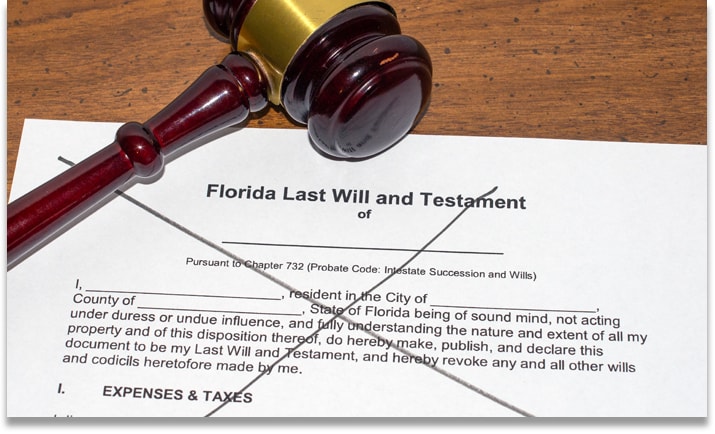
Intestate succession refers to the process under Florida law for distributing a person’s probate assets when those assets are not effectively disposed of by a valid will. When a person passes away without a valid will governing those assets, Florida’s intestate succession laws determine which heirs are entitled to inherit.
This probate process can involve court proceedings, expenses, and legal requirements for administering the deceased person’s estate. Rather than the decedent choosing who inherits through a valid will, Florida law establishes who is entitled to receive the intestate property.
Key Takeaways
- Florida intestate succession applies when probate assets are not effectively disposed of by a valid will.
- Florida law determines which heirs inherit intestate property and in what order.
- A surviving spouse may receive all or one-half of the intestate estate depending on whether the decedent or surviving spouse has descendants from another relationship.
- If there is no surviving spouse, Florida law generally looks first to the decedent’s descendants, then parents, siblings, and more remote relatives.
- Assets with valid beneficiary designations or survivorship rights may pass outside the intestate probate estate.
Florida Intestate Succession
Florida Statute Sections 732.101-.109 cover intestate succession. When someone dies without a valid will disposing of their probate assets, those intestate assets pass to heirs according to the order established by Florida law. The heirs follow a specific order in Florida.
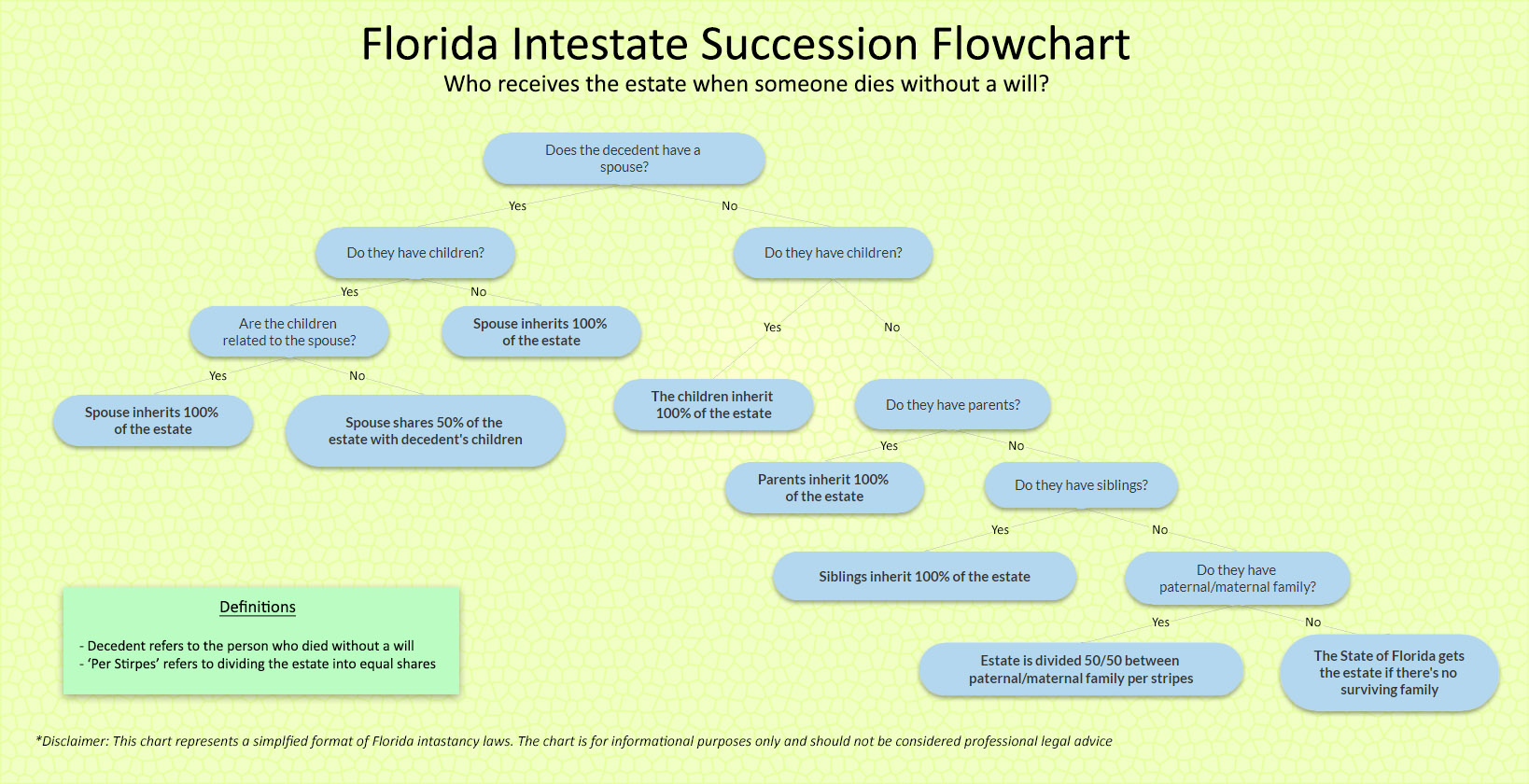
- If the decedent is survived by a spouse and has no surviving descendants, the surviving spouse generally receives the entire intestate estate. The spouse may also receive the entire intestate estate when all of the decedent’s descendants are also descendants of the surviving spouse and the surviving spouse has no other descendants.
- If the decedent has surviving descendants, the amount inherited by the surviving spouse depends on the family circumstances. If the decedent has descendants who are not descendants of the surviving spouse, the surviving spouse generally receives one-half of the intestate estate and the decedent’s descendants receive the other half. The surviving spouse may also receive one-half when all of the decedent’s descendants are shared with the spouse but the surviving spouse has other descendants.
- If there is no surviving spouse, the intestate estate generally passes first to the decedent’s descendants. If there are no surviving descendants, the estate passes to the decedent’s parents equally, or to the surviving parent.
- If there is no surviving spouse, descendant, or parent, the estate generally passes to the decedent’s brothers and sisters and to the descendants of any deceased brothers or sisters.
Of course, family units may be complicated in today’s world. For example, usually the surviving spouse gets everything. However, if the decedent has children from a previous marriage, the surviving spouse may get half the estate; the other half goes to the child/children from the first marriage. Basically, each scenario may have complications. Intestate succession may also become relevant when a will is successfully challenged and there is no other valid will controlling the property. Learn more about contesting a will in Florida.
If you would like more information on how assets are distributed in the State of Florida, we wrote an article on Florida probate rules and processes that covers this subject in greater detail.
How Does Florida Homestead Property Pass Without a Will?
Florida homestead property can be subject to special inheritance rules. If a decedent’s homestead is not validly devised and the decedent is survived by a spouse and one or more descendants, the surviving spouse generally receives a life estate in the homestead, while the descendants receive the remainder interest.
The surviving spouse may instead elect to receive an undivided one-half interest in the homestead as a tenant in common, with the remaining one-half passing to the decedent’s descendants. Florida law generally requires this election to be made within six months after the decedent’s death.
These homestead rules can differ from the way other intestate assets are distributed, so the treatment of a Florida residence should be evaluated separately from the rest of the estate.
How Are Intestate Shares Divided Among Descendants?
Florida generally distributes intestate property to descendants per stirpes. This means that if a child of the decedent has already died but left descendants, that child’s share may pass down to his or her descendants.
For example, if a decedent had two children and one child died before the decedent but left two children of their own, the surviving child would generally receive one-half of the applicable intestate share, while the deceased child’s one-half share would be divided among that child’s descendants.
This rule can also apply to more remote family members when property passes to collateral heirs.
What’s Not Affected by Intestate Succession?
When someone dies without a will, there are some parts of their estate that may not have to go through Probate Court. If you have funds in a 401K, or other retirement account and have designated beneficiaries, this avoids intestate succession.
Also, property owned jointly with a right of survivorship may pass directly to the surviving owner without probate. However, jointly owned property without survivorship rights may still be subject to probate.
So, any account that designates who inherits the funds when you pass away is protected from intestate succession.
Can Intestate Succession Be Avoided?
Proper estate planning avoids intestate succession. A well-prepared estate plan may include a will, trust, beneficiary designations, and other tools that direct how assets pass at death. Powers of attorney and health care directives serve different purposes during a person’s lifetime.
How many people want the State deciding how their hard earned life’s savings are distributed? How many folks want to pay the State money after they die?
Properly prepared estate plans can help direct how assets are distributed, reduce the risk of unnecessary probate proceedings, provide for minor children, and help carry out a person’s wishes. Depending on the circumstances, certain planning strategies may also provide tax or other financial benefits.
Summary
When someone dies without a valid will disposing of their probate assets, those assets may pass through Florida’s intestate succession laws. It’s important to note, “intestate” does not mean that the state owns the property. This simply means that Florida law determines which heirs are entitled to receive the intestate property.
This process varies depending on the state where the decedent resides at the time of death. Florida has a complex and elaborate process in determining who receives these assets. In short, the first to inherit is the surviving spouse. There must be a valid marriage to be a surviving spouse. If there are no children, the spouse gets everything.
In Florida, a personal representative generally must be represented by an attorney admitted to practice in Florida, unless the personal representative is the sole interested person. A personal representative who is a Florida-licensed attorney may also represent themselves. Since the process involved with intestate succession is very in-depth, it’s vital to work with an experienced Florida probate attorney. Doing so will help avoid confusion and disputes among potential beneficiaries and ensure assets are correctly distributed in accordance with state law.

Cited Sources
- Florida Legislature (2022). The 2022 Florida Statutes (including 2022 Special Session A and 2023 Special Session B). Retrieved from https://www.leg.state.fl.us/statutes/index.cfm?App_mode=Display_Statute&URL=0700-0799/0732/0732.html