

Florida Probate Rules And Processes
Probate is a court-supervised legal process used to administer and distribute certain assets owned by an individual at death. Not every asset is required to go through probate, as some property may pass directly to beneficiaries or co-owners outside the probate process. This legal process varies from state-to-state and helps ensure probate assets are administered and distributed according to the decedent’s will or Florida law. This article discusses Florida probate rules and processes.
It’s important to note that information within this page can help guide someone in the right direction and answer general questions; however, this is not a substitute for professional legal advice. Under Florida Probate Rule 5.030, a personal representative generally must be represented by an attorney admitted to practice in Florida, unless the personal representative is the sole interested person. A personal representative who is a Florida-licensed attorney may also represent themselves.
Key Takeaways
- Florida probate is a court-supervised process used to administer certain assets after a person dies.
- The two primary forms of probate administration in Florida are formal administration and summary administration, while certain small estates may qualify for Disposition of Personal Property Without Administration.
- A personal representative generally must be represented by a Florida attorney, subject to limited exceptions under Florida Probate Rule 5.030.
- Florida probate involves specific rules and deadlines concerning wills, creditors, beneficiaries, estate accounting, and distribution of assets.
- Florida’s Probate Rules are periodically amended by the Florida Supreme Court, making it important to consult the current rules and applicable statutes.
Free Guide On Probating a Will in Florida
What is Probate?
Probate is a court-supervised process that distributes assets of deceased individuals. The court assigns a personal representative (PR) to carry out the terms of a will. Usually this person is named in the will document. When a person passes away without a will, the court assigns a PR to coordinate estate matters. The personal representative has many duties and may wish to consult an attorney for guidance. Simply put, duties fall in three categories:
- Compiling assets- This involves assembling, securing, and valuing the decedent’s property.
- Paying bills- The personal representative must identify and address valid creditor claims, taxes, expenses of administration, and other estate obligations in accordance with Florida law. Not every claimed debt is necessarily paid, and Florida law establishes deadlines and priorities for creditor claims.
- Distribution to heirs- After all bills are paid, inheritance funds and property are distributed according to the will. If there is no will, Florida’s intestate succession laws dictate how funds and property pass to heirs.
Florida Statute 733.212 requires the personal representative to promptly serve a Notice of Administration on specified persons known to the personal representative, including the surviving spouse and beneficiaries. The personal representative must also publish a notice to creditors and, after a diligent search, promptly serve reasonably ascertainable creditors as required by Florida Statute 733.2121. Since there are legal requirements attached to the personal representative’s duties, it remains wise to contact an experienced attorney for guidance throughout the process.
Probate Definitions
To help readers better understand the context of the article, here are some of the most common terms found within this content and/or used throughout the probate process.
Administration – This refers to the legal distribution of someone’s assets in Probate Court after they pass away.
County Clerk of Court – Probate cases are filed with the Clerk of the Circuit Court in the county where the venue is proper. The clerk maintains the court records and processes probate filings, while probate matters are heard and decided by the circuit court.
Decedent – A deceased individual
Intestate – When a person dies without a valid will, or when part of the estate is not effectively disposed of by a will, that property passes according to Florida’s intestate succession laws. This will be discussed further in the article.
Probate Court – This is a common term used to describe the division of Florida’s Circuit Court that handles probate matters, including the administration of decedents’ estates. The Clerk of the Circuit Court maintains the case filings and records, while probate matters are heard and decided by the circuit court.
Personal Representative – Someone who’s legally appointed to oversee the distribution of assets from a deceased person’s estate.
Beneficiary/Beneficiaries – In the probate context, a beneficiary generally refers to an heir at law in an intestate estate or a devisee who is entitled to receive property under a will. In certain circumstances, a trustee receiving a devise on behalf of a trust may also be considered a beneficiary of the estate.
Executor – A commonly used term for the person named in a will to administer an estate. In Florida, the legal term is “personal representative,” and the person nominated in the will must generally be appointed by the court before exercising authority over the estate.
Notice of Administration – Florida Statute 733.212 requires the personal representative to promptly serve a Notice of Administration on specified persons known to the personal representative, including the surviving spouse and beneficiaries. The personal representative must also publish a Notice to Creditors and, after a diligent search, promptly serve reasonably ascertainable creditors as required by Florida Statute 733.2121. Since there are legal requirements attached to the personal representative’s duties, it remains wise to contact an experienced attorney for guidance throughout the process.
Probate Litigation – Basically, this is used to describe a legal dispute during the probate process. The most common types of probate disputes include: challenges to wills/trusts, legal disputes over guardianship, etc.
Probate Process Overview
Under Florida law, there are two primary types of probate administration: formal administration and summary administration. Florida also provides a limited procedure known as Disposition of Personal Property Without Administration, which may be available for certain very small estates. Below is a description of each of these procedures.
Formal Administration – Formal administration is also simply referred to as “formal probate.” As the name suggests, this type of proceeding is the standard form of probate and by far the most common. Formal probate administration takes place in the local Circuit Court of the County in which the decedent resided at the time of their death. The process starts once an individual passes away and the executor of the will (or other interested party) asks to be appointed as personal representative of the decedent’s estate. The beneficiaries named in the estate are then provided notice and given a chance to raise any formal objection(s).
Summary Administration – This form of probate may be available when the value of the entire estate subject to administration in Florida, less the value of property exempt from creditor claims, does not exceed $150,000. Summary Administration may also be available when the decedent has been dead for more than two years. The process of this type of administration is initiated by filing a Petition for Summary Administration by a beneficiary or a person nominated as personal representative in the decedent’s will, subject to Florida’s statutory requirements regarding signatures, joinder, and notice. In short, this is an expedited version of probate.
Disposition Without Administration – As the words “without administration” may suggest, this process allows certain very small estates to transfer personal property without opening a formal probate administration. Under Florida law, this procedure may be available when the decedent left only exempt personal property and nonexempt personal property whose value does not exceed the amount of preferred funeral expenses and reasonable and necessary medical and hospital expenses from the last 60 days of the decedent’s final illness.
An interested party may apply to the court for authorization to transfer the qualifying personal property without formal administration.
Since there’s no formal court hearing for administration, in order to recover assets, a form must be filed called the “Disposition of Personal Property Without Administration.”
What Happens in Probate Court?
The probate process begins when the custodian of the will deposits the original document with the Court clerk. The clerk will start a file which includes a death certificate. There is a fee for opening a probate case file. The next step involves a circuit court judge.
The petition for administration identifies the known beneficiaries and requests the appointment of a personal representative. The court reviews the petition and determines whether the person seeking appointment is entitled and qualified to serve. If this person is named in the will, the judge will examine their qualifications. If the named individual meets necessary qualifications, the judge issues “Letters of Administration.” At this point, the PR takes over the estate administration. Of course, if disputes arise later on, the judge may hold a hearing to settle matters. Once again, an attorney’s advice is necessary throughout the process.
Does Florida Recognize Transfer on Death Deeds?
No. Florida does not recognize property transfer on death deeds. Real estate may not be transferred in this manner. In Florida, a Ladybird Deed operates like a transfer on death deed. Some estate plans use a ladybird deed. When real estate is owned jointly with a right of survivorship, including certain property owned by married couples as tenants by the entirety, the property may pass directly to the surviving owner at death.
However, if someone is the sole owner of a home, property, or piece of land at the time of death, that real estate may need to go through probate court before ownership can be transferred, depending on how the property is titled and whether an exception or other estate-planning mechanism applies.
If the real estate becomes part of the probate estate and is not effectively disposed of by a valid will, Florida’s intestate succession laws may determine who inherits the property. The surviving spouse’s share depends on the decedent’s family circumstances, and Florida homestead property is also subject to special inheritance rules.
How Long Do You Have to File Probate After Death?
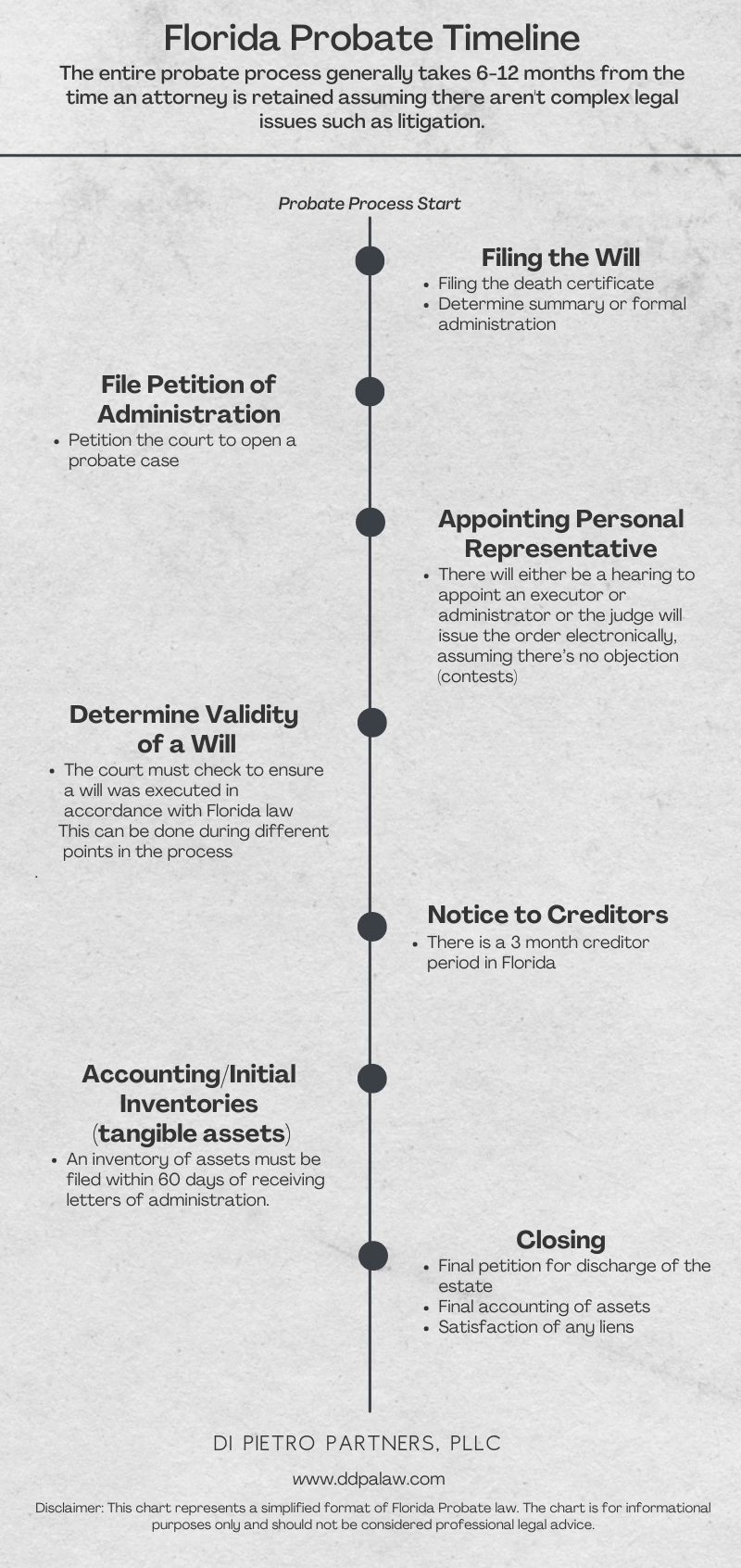
Florida’s probate process includes numerous laws and deadlines. Under Florida law, the custodian of a will must deposit the original will with the clerk of the court having venue of the estate within 10 days after receiving information that the testator has died. This 10-day requirement applies to depositing the will; it is not a general deadline for opening probate or notifying the court of the death.
After the appropriate probate proceeding is initiated, the court may admit the will to probate and appoint a qualified personal representative. The court then issues Letters of Administration, which provide the personal representative with authority to administer the estate.
If a family member dies intestate (without a will), an heir must go to court and obtain “Letters of Administration.” In this case, probate court assigns a relative to serve as the personal representative. This assigned person has the authority to settle all matters regarding the decedent’s estate. Once again, an experienced probate attorney can guide your family through this process.
Florida Probate Timeline
This section provides information on each major step involved in the Florida probate process.
- Filing The Will
The custodian of a will must deposit the original will with the clerk of the court having the venue of the decedent’s estate within 10 days after receiving information that the testator has died. In most cases, the venue is in the Florida county where the decedent was domiciled at the time of death. For example, if the decedent was domiciled in Fort Lauderdale, the matter would generally be handled in Broward County. You can learn more about the Broward County Probate Court in this article. - Petition for Administration
Filing a Petition for Administration is generally the next step in opening a formal probate estate. The petition asks the court to administer the decedent’s estate and, when appropriate, appoint a personal representative. This process applies whether the decedent died with a valid will or without one. - Appoint Personal Representative
The next step is the appointment of a personal representative. This individual is responsible for gathering and distributing assets of the individual who passed away. You can read more about appointing personal representatives and their duties in this article. - Admit the Will to Probate
The court must determine whether the will can be admitted to probate under Florida law. A Florida will generally must be in writing, signed by the testator, and witnessed by at least two people who sign in the presence of the testator and each other. A will does not generally have to be notarized to be valid, although a properly executed self-proving affidavit can allow the will to be admitted to probate without further proof from the witnesses. Issues such as undue influence or lack of capacity may become relevant if the validity of the will is challenged. - Notice to Creditors
The Notice to Creditors is the formal notification process that gives creditors the opportunity to become aware of the decedent’s death and file claims against the estate.
Under Florida law, the personal representative must promptly publish a Notice to Creditors unless creditor claims are otherwise barred.The notice must be published once a week for two consecutive weeks in a newspaper published in the county where the estate is being administered or, if no newspaper is published in that county, in a newspaper of general circulation there.
The personal representative must also make a diligent search for creditors who are reasonably ascertainable and promptly serve those creditors with a copy of the notice. Florida Probate Rule 5.241 also requires proof of publication to be filed with the court within 45 days after the first publication.
The notice advises creditors that claims against the estate must be filed within the deadlines established by Florida law or they may be barred.
- Accounting
The personal representative must account for the assets and transactions of the estate. This may include reporting receipts, disbursements, distributions, and other estate activity. When a final accounting is required, it is served on interested persons, who generally have 30 days to file written objections. If no timely objection is filed, the accounting may be approved without a hearing. If objections are filed, the court may hold a hearing to resolve them. - Closing
After accounting has concluded, the personal representative will file a final petition for discharge of the estate. Once all assets are distributed and all debts have been taken care of, the court enters an order to finally close the estate.
Common Questions About Florida Probate
When is Probate Required? – Probate is generally required for assets owned solely in the decedent’s name at death that do not have a valid beneficiary designation or other mechanism for automatic transfer. However, if the decedent has a well-executed trust document the family may avoid probate court. Also, any property held in joint tenancy with full survivorship rights avoids probate court. Bank accounts, IRA’s, 401K’s, and any financial assets with POD or beneficiary designations pass directly to heirs and do NOT go through probate court. However, any assets without proper beneficiary designations or another method of automatic transfer may need to go through probate. Banks and other institutions will not release funds without proper transfer designations. So, if a family member passes away without a proper estate plan contact an experienced probate attorney immediately.
What is Probate Estate? – A probate estate generally consists of the assets owned by a deceased person that must be administered through the probate process. Probate assets commonly include property owned solely in the decedent’s name that does not have a beneficiary designation, right of survivorship, or another method of automatic transfer at death.
Family members may need to go through probate before selling an inherited house or transferring other property owned solely by the deceased person. For example, if someone passes away and solely owns a $35,000 car, the family may not be able to transfer ownership until the proper probate authority is established.
Once the court appoints a personal representative and issues Letters of Administration, that person has authority to administer estate assets in accordance with Florida law. Estate matters are often complicated and require an attorney’s assistance.
How Long after a Person Dies Will Beneficiaries Be Notified? – Personal Representatives must follow timelines settling Florida Probate cases. Once the court assigns a personal representative that individual must notify all heirs and beneficiaries. After viewing the will, or learning about any inheritance, beneficiaries may disagree, or object, to terms, financial conditions, or any other part of the proceedings. However, there is a very limited time to notify probate court regarding any objections. Considering the time constraints, one should hire an attorney immediately for assistance.
Do all estates require probate? – No. Whether probate is required depends primarily on how the decedent’s assets were owned and whether they have a valid method of transfer at death. Assets owned solely in the decedent’s name without a beneficiary designation, right of survivorship, or other non-probate transfer mechanism generally require probate.
A will does not itself avoid probate; instead, it generally directs how probate assets should be distributed. Assets held in a properly funded trust, accounts with valid beneficiary or payable-on-death designations, and certain jointly owned property with survivorship rights may pass outside probate.
What Assets Go Through Probate? – In Florida, probate generally applies to assets owned solely in the decedent’s name at death or co-owned without a right of survivorship or another mechanism for automatic transfer. Examples may include individually owned bank or investment accounts, certain real estate, vehicles, and other personal property.
Assets held in a properly funded living trust generally avoid probate. Property owned with rights of survivorship may also pass directly to the surviving owner. Life insurance policies, retirement accounts, and other financial assets with valid beneficiary designations generally pass directly to the named beneficiaries rather than through probate.
Do I need an attorney? – In Florida, a personal representative generally must be represented by an attorney admitted to practice in Florida. An exception applies when the personal representative is the sole interested person, and a personal representative who is a Florida-licensed attorney may also represent themselves.
How long does probate take? – The length of probate depends on a variety of factors, including the size and complexity of the estate, creditor claims, disputes among beneficiaries, tax issues, and other circumstances. Many Florida probate estates can take several months to complete. Florida’s probate rules generally contemplate filing the final accounting and petition for discharge within 12 months after Letters of Administration are issued for estates not filing a federal estate tax return, although the court may grant additional time when necessary.
What happens to someone’s bank account after they die? – If the deceased individual has a beneficiary or Payable on Death (POD) listed on the account or has established a sound estate plan with a trust, their heirs will be able to access the funds. However, In cases where someone dies without the aforementioned provisions in place, the bank will not release the money.
For example, if a family member of the deceased presents a death certificate and has no trust document to prove they are the rightful heir, the bank holds on to the money. In this case, the estate must go through probate to access the funds.
Of course, having a valid will in place and/or hiring experienced legal counsel increases the likelihood of a smooth and prompt hearing.
When Someone Dies Without a Will
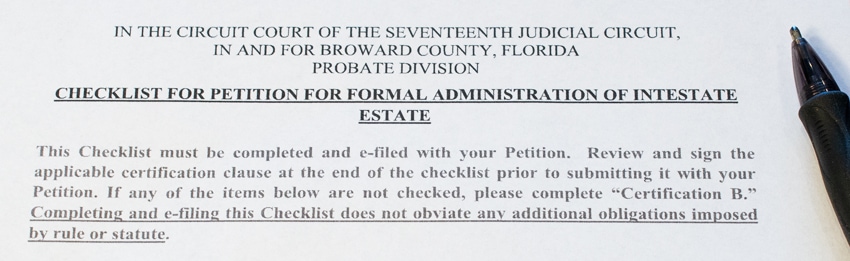
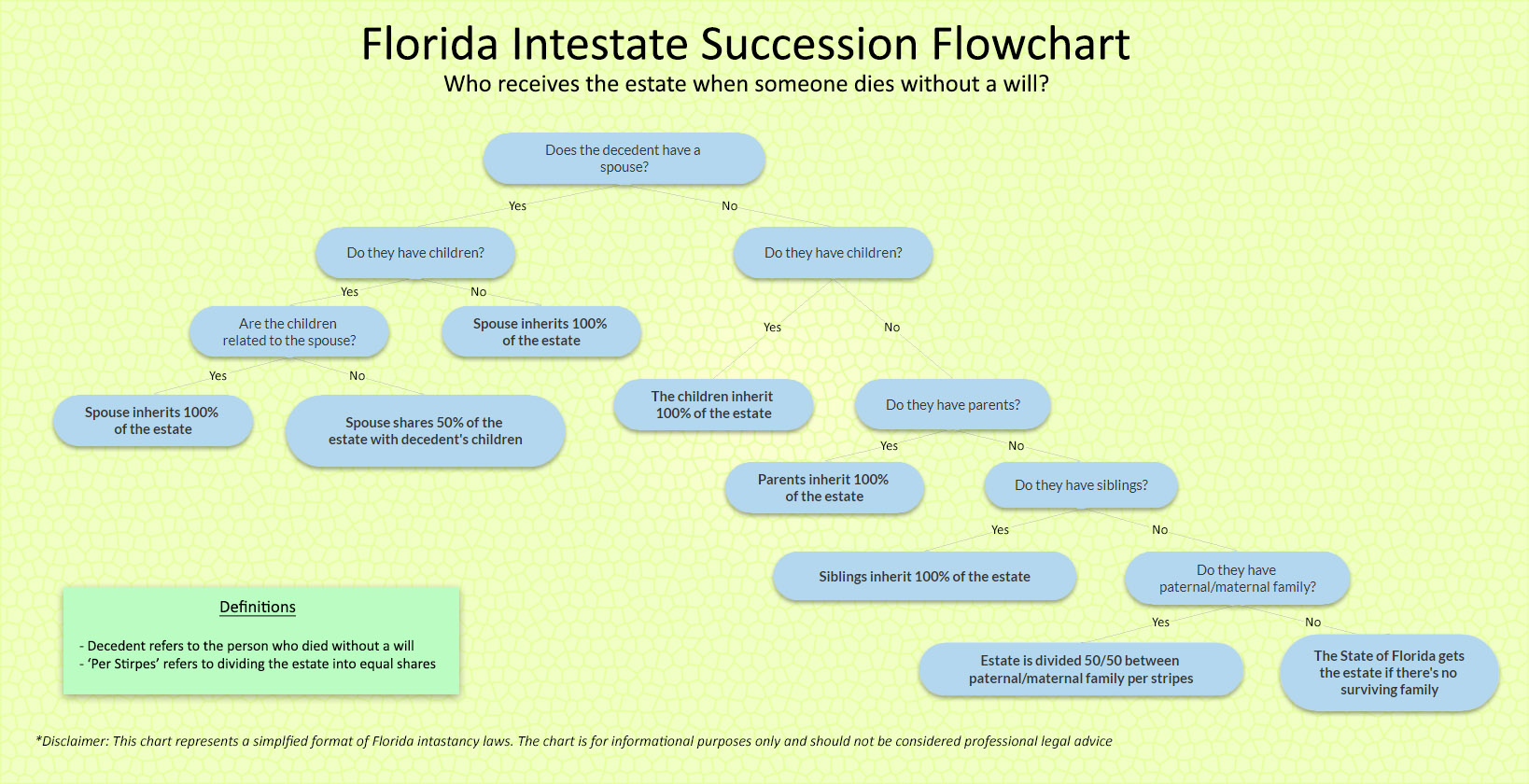
When someone dies without a valid will in Florida, their assets are declared “intestate.” It’s important to note, that “intestate” does not mean that the property now belongs to the State of Florida. In fact, Florida has a specific process in determining who receives the decedent’s assets in the absence of a valid will. The full process can be found in Chapter 732 of The Florida Statutes. Below is a summary of this process.
- If the decedent is survived by a spouse and has no surviving descendants, the surviving spouse generally receives the entire intestate estate.
- If the decedent is survived by a spouse and one or more descendants, all of whom are also descendants of the surviving spouse, the surviving spouse generally receives the entire intestate estate if the surviving spouse has no other descendants.
- If the decedent is survived by one or more descendants who are not descendants of the surviving spouse, the surviving spouse generally receives one-half of the intestate estate, and the other half passes to the decedent’s descendants.
- If the decedent was not married at the time of death, the intestate estate generally passes first to the decedent’s descendants. If there are no surviving descendants, it passes to the decedent’s parents, then to siblings and descendants of deceased siblings, followed by more remote relatives in the order established by Florida law.
- If the deceased person was not married and also has no living immediate family members, the inheritance will pass to surviving parents of the decedent.
- If the decedent has no surviving spouse, descendants, parents, siblings, or descendants of siblings, Florida law looks to more remote relatives in a specific statutory order. If no person is ultimately entitled to inherit, the estate may escheat to the State of Florida.
- As discussed, this is a summarized version of the Florida probate law specific to intestate succession and wills. The full laws are more in-depth and have various exceptions depending on several circumstances. To put this in perspective, here’s an excerpt from section 732.108 of the Florida Statutes regarding adopted children/children born out of wedlock.
“For the purpose of intestate succession by or from an adopted person, the adopted person is a descendant of the adopting parent and is one of the natural kindred of all members of the adopting parent’s family, and is not a descendant of his or her natural parents, nor is he or she one of the kindred of any member of the natural parent’s family or any prior adoptive parent’s family, except that:
(a) Adoption of a child by the spouse of a natural parent has no effect on the relationship between the child and the natural parent or the natural parent’s family.
(b) Adoption of a child by a natural parent’s spouse who married the natural parent after the death of the other natural parent has no effect on the relationship between the child and the family of the deceased natural parent.
(c) Adoption of a child by a close relative, as defined in s. 63.172(2), has no effect on the relationship between the child and the families of the deceased natural parents…”
(Florida Statutes § 732.108, 2026, Adopted persons and persons born out of wedlock.)
As you can see, this process is very in-depth and often causes confusion/disagreements among beneficiaries. As a result, it’s vital to work with a lawyer that’s experienced in Florida probate rules when it comes to issues involving probate court/intestate succession.
Disputes in Probate Court
Ideally, the final wishes of the decedent are written in a will and agreed upon among beneficiaries; however, this isn’t always the case. As previously discussed, the process becomes more complex when someone dies without a will, or there’s a legal dispute such as a contested will, or challenges to a trust.
In Florida, wills may be contested on the grounds of validity (i.e the will wasn’t properly executed). Wills may also be challenged when the person drafting/changing the will does not have legal mental capacity to understand the impact of these documents. These are only a couple examples of legal disputes over wills; the facts and circumstances differ for each case and these disputes often require experienced probate litigation counsel.
Similar to a will, a trust may also be challenged in court. Legal disputes over trusts may include: lack of mental capacity by the settlor, undue influence over the settlor, improper witnessing/execution of the trust, and a multitude of other reasons. Trust disputes are often complex; therefore, experienced legal counsel is strongly recommended in these scenarios.
These types of cases are also done through probate; however, they’re commonly referred to as “probate litigation,” as opposed to “probate administration.”
Summary Of Florida Probate Rules
When it comes to probate in Florida, the two primary types of probate administration are formal administration and summary administration. Florida also provides a limited procedure known as Disposition of Personal Property Without Administration for certain qualifying estates. Formal and summary administration account for almost all probate cases throughout the state. In Florida probate proceedings, a personal representative generally must be represented by an attorney admitted to practice in Florida unless the personal representative is the sole interested person. A personal representative who is a Florida-licensed attorney may also represent themselves. Whether other interested parties need separate legal representation depends on the circumstances of the case.
If you need assistance with probate administration, a contested will, an inheritance dispute, or another Florida probate matter, contact Di Pietro Partners for a confidential consultation with an experienced Florida probate attorney. We represent clients throughout Florida.
954-712-3070 (Local)
800-712-8462 (Toll free)
Florida Probate Rules Committee
The Florida Probate Rules Committee is a specialized committee within the Florida Bar responsible for reviewing, proposing, and amending the procedural rules governing probate, guardianship, and trust proceedings in Florida courts. The committee works in conjunction with the Florida Supreme Court, which has the authority to adopt or reject proposed rule changes.
The committee is composed of attorneys, judges, and legal professionals with expertise in Florida probate law. Their recommendations impact how probate cases are processed in court, ensuring that legal procedures remain effective and up to date. As part of its ongoing efforts to ensure clarity, efficiency, and alignment with Florida statutes, the Florida Probate Rules Committee regularly reviews and proposes amendments to the Florida Probate Rules.
These changes, once approved by the Florida Supreme Court, help streamline probate procedures, address emerging legal issues, and enhance protections for beneficiaries, personal representatives, and other parties involved in probate proceedings. Below is a summary of the most recent amendments to Florida’s probate rules
Florida Probate Law Updates (By Year)
2021 Amendments to Florida Probate Rules
In 2021, the Florida Supreme Court adopted amendments to the Florida Probate Rules, as proposed by the Florida Probate Rules Committee.
| Rule | 2021 Amendment |
|---|---|
| Rule 5.200 – Petition for Administration | Added a requirement that the petition state whether the proposed personal representative has been convicted in any state or foreign jurisdiction of abuse, neglect, or exploitation of an elderly person or disabled adult. |
| Rule 5.320 – Oath of Personal Representative | Updated the oath to include a statement that the personal representative has not been convicted of abuse, neglect, or exploitation of an elderly person or disabled adult. The notary block was also updated to allow for online notarization. |
| Rule 5.405 – Proceedings to Determine Protected Homestead Status of Real Property | Renamed and expanded the rule to address certain real property owned by a trust and to require the petition to state how the real property was owned at the time of the decedent’s death. |
| Rules 5.020, 5.340, 5.402, 5.403, and 5.404 | Updated rule references and related committee notes to conform with the changes to Rule 5.405. |
| Rule 5.555 – Guardianships of Minors | Updated the statutory references in the committee notes, including substituting “property” for “asset” in the reference to section 69.031, Florida Statutes. |
The 2021 amendments became effective November 4, 2021, upon release of the Florida Supreme Court’s opinion
2022 Amendments to Florida Probate Rules
In 2022, the Florida Supreme Court amended Florida Probate Rule 5.080 as part of a broader set of rule changes addressing the use of communication technology in court proceedings.
| Rule | 2022 Amendment |
|---|---|
| Rule 5.080 – Discovery, Subpoena, and Taking Testimony | Amended to incorporate Florida Rule of Civil Procedure 1.451, which governs the taking of testimony through communication technology in probate and guardianship proceedings. |
The amendment to Rule 5.080 became effective October 1, 2022.
2023 Amendments to Florida Probate Rules
In 2023, the Florida Supreme Court adopted multiple amendments to the Florida Probate Rules through separate rulemaking proceedings. Significant changes included:
| Rule | 2023 Amendment |
|---|---|
| Rule 5.040 – Notice | Clarified that evidence of delivery is not required when formal notice is served by first-class mail in circumstances permitted by the rule. |
| Rule 5.330 – Execution by Personal Representative | Revised to require the personal representative to sign the petition for discharge, conforming the rule to Rule 5.400. |
| Rule 5.930 – Affidavit of Qualified Custodian of Electronic Will | Added a new form affidavit for qualified custodians of electronic wills. |
| Rule 5.630 – Petition for Approval of Acts | Updated to reflect changes in Florida guardianship law, including the addition of a reference to Section 744.422 and removal of provisions related to repealed Section 744.441(2). |
| Rule 5.631 – Professional Guardian and Life-Prolonging Procedures | Added a new rule establishing procedures for a professional guardian seeking court approval for an order not to resuscitate or to withhold life-prolonging procedures. |
| Rule 5.649 – Guardian Advocate | Amended to require a petition for appointment of a guardian advocate to state whether authority is sought to pursue periodic support for a person with a developmental disability. |
| Rule 5.904 – Initial and Annual Guardianship Plans | Updated adult guardianship plan forms to require disclosure of certain existing health-care directives, including do-not-resuscitate orders, health-care surrogate decisions, living wills, and anatomical gifts. |
| Rules 5.905 and 5.906 – Guardian Advocacy Forms | Updated forms relating to the appointment and authority of guardian advocates to conform with statutory changes affecting guardian advocacy proceedings. |
| Rule 5.920 – Protection Against Exploitation of a Vulnerable Adult | Updated forms used in proceedings seeking injunctions for protection against exploitation of vulnerable adults to conform with statutory changes. |
The amendments to Rules 5.040, 5.330, and 5.930 became effective April 1, 2023.
The later amendments responding to 2023 legislation including Rules 5.630, 5.631, 5.649, 5.904, 5.905, 5.906, and 5.920 became effective December 14, 2023, upon release of the Florida Supreme Court’s opinion.
2024 Amendments to Florida Probate Rules
In 2024, the Florida Supreme Court adopted several amendments to the Florida Probate Rules through separate rulemaking proceedings. Significant changes that became effective during 2024 included:
| Rule | 2024 Amendment |
|---|---|
| Rule 5.025 – Adversary Proceedings | Reorganized the list of specific adversary proceedings and expressly added proceedings contesting the validity of a will. |
| Rule 5.340 – Inventory | Amended the elective-share provisions to require that elective estate assets be valued as required by law. |
| Rule 5.405 – Proceedings to Determine Protected Homestead Status of Real Property | Expanded and clarified the required contents of petitions to determine protected homestead status and added formal-notice requirements for interested persons. |
| Rule 5.240 – Notice of Administration | Added notice concerning the Florida Uniform Disposition of Community Property Rights at Death Act and the circumstances requiring a written demand. |
| Rule 5.241 – Notice to Creditors | Added similar notice concerning potential application of the Florida Uniform Disposition of Community Property Rights at Death Act. |
| Rule 5.550 – Petition to Determine Incapacity | Added requirements addressing supported decision-making agreements and other forms of assistance already available to the alleged incapacitated person. |
| Rule 5.649 – Guardian Advocate | Added requirements concerning supported decision-making and other assistance, including whether rights can be exercised with assistance. |
| Rule 5.681 – Restoration of Rights of Person With Developmental Disability | Added consideration of whether other forms of assistance could serve as alternatives to continued guardian-advocate involvement. |
| Form 5.905 – Guardian Advocate Form | Updated the form to address decision-making agreements, advance directives, powers of attorney, and whether those alternatives are sufficient. |
The amendments to Rules 5.025, 5.340, and 5.405 became effective October 1, 2024. The legislation-related amendments to Rules 5.240, 5.241, 5.550, 5.649, 5.681, and Form 5.905 became effective September 5, 2024.
2025 Amendments to Florida Probate Rules
Several amendments to the Florida Probate Rules became effective during 2025. Some were adopted by the Florida Supreme Court in late 2024 with a 2025 effective date, while others were adopted during 2025.
| Rule | 2025 Amendment |
|---|---|
| Rule 5.320 – Oath of Personal Representative | Amended to provide separate oath requirements and forms for individuals and entities serving as personal representatives. |
| Rule 5.550 – Petition to Determine Incapacity | Amended to require that both the notice of the petition to determine incapacity and the petition itself be read to the alleged incapacitated person when served. |
| Rule 5.040 – Notice | Amended to require electronic service of formal notice on an attorney who has appeared for an interested person, in accordance with Florida’s electronic-service rules. |
| Rule 5.499 – Objection to Personal Representative’s Proof of Claim | Amended to require service of an objection on the claimant at the time the objection is filed or promptly thereafter, rather than within 10 days after filing. |
| Form 5.904 – Initial and Annual Guardianship Plans | Updated the annual guardianship plan form to align the timing of required medical examinations with Florida law. |
| Rule 5.405 – Protected Homestead Status of Real Property | Amended to require petitions to state whether the decedent died testate or intestate and, when applicable, how a surviving spouse waived homestead rights. |
The amendments to Rules 5.320 and 5.550 became effective January 1, 2025. Rules 5.040, 5.499, and Form 5.904 became effective July 1, 2025. The Rule 5.920 amendments became effective August 28, 2025, and the Rule 5.405 amendments became effective October 1, 2025.
Current Status of Florida Probate Rules (2026)
Florida’s Probate Rules have continued to be amended in 2026. Amendments effective January 1, 2026 included a change to Rule 5.010, and additional amendments effective July 16, 2026 affected Rules 5.025, 5.425, and 5.530. Other proposed or adopted amendments may have different effective dates, so practitioners and interested parties should consult the current Florida Probate Rules and Florida Supreme Court orders for the latest requirements.

Cited Sources
- Florida Legislature (2022). The 2022 Florida Statutes (including 2022 Special Session A and 2023 Special Session B). Retrieved from http://www.leg.state.fl.us/Statutes/index.cfm?App_mode=Display_Statute&URL=0700-0799/0733/Sections/0733.212.html
- Amendments to The Florida Probate Rules — 2021 Fast-Track Report. Retrieved from https://www-media.floridabar.org/uploads/2021/11/Amendments-to-The-Florida-Probate-Rules-%E2%80%94-2021-Fast-Track-Report.pdf
- Florida Probate Rules Committee https://www.floridabar.org/about/cmtes/cmte-cm230/