

Inheritance laws may be found in two places. The Florida Probate Code (Chapter 732) contains laws relating to wills. It also includes statutes regarding folks that pass away without a will. Additionally, the Florida Trust Code (Chapter 736) lists statutes relating to trusts.
The extensive laws are very briefly summarized below. However, due to the complex nature of the statutes, contact an experienced Florida probate attorney that specializes in this area regarding inheritance matters.
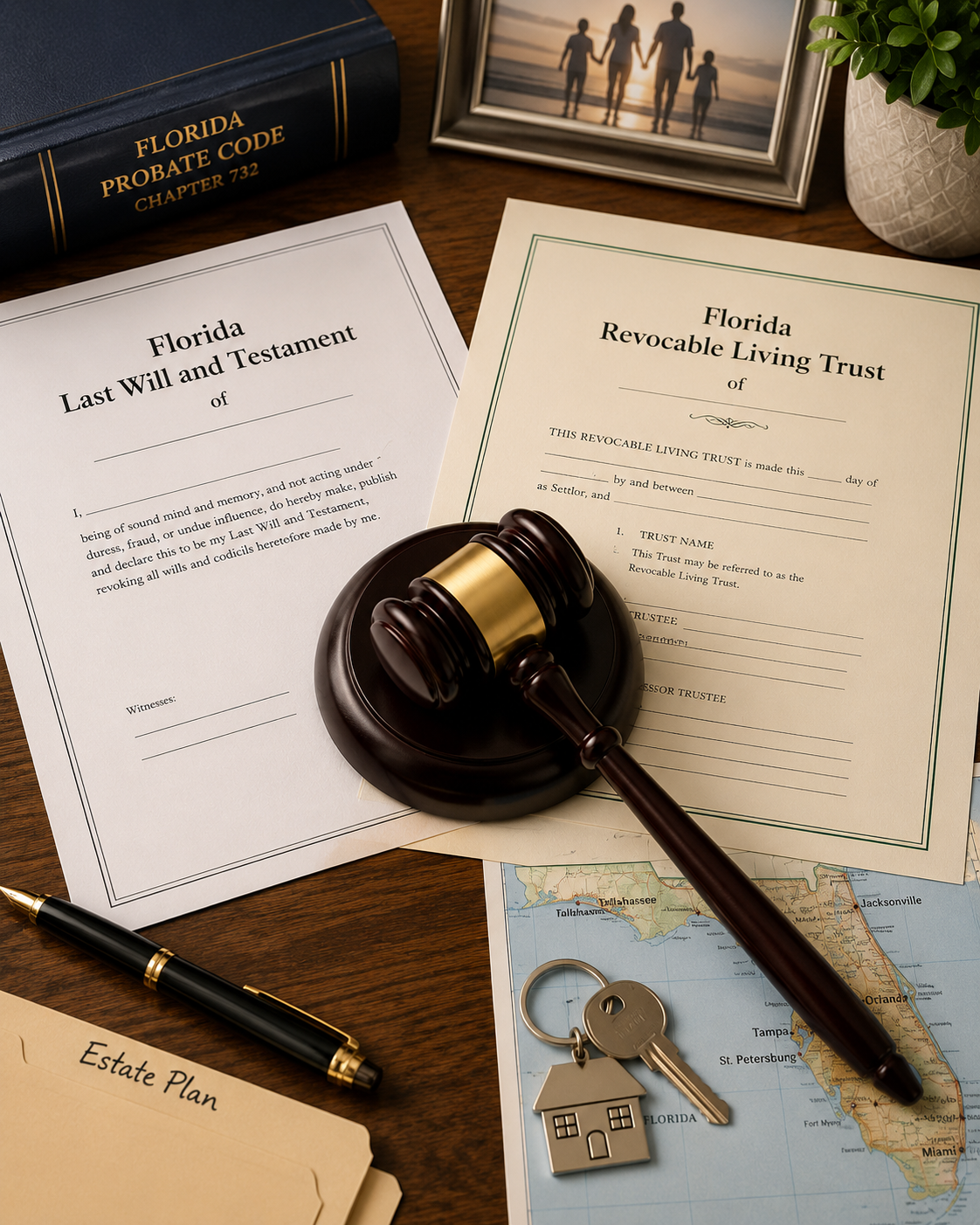
The Florida Probate Code (Chapter 732)
- Part I- Intestate Succession (732.101-732.111) This section details laws that pertain to decedents that pass away without a will. It covers who receives assets when there is no will. Of course, an attorney’s guidance is very helpful in these matters.
- Part II- Elective Share of Surviving Spouse: Community Property (732.201-732.228) Community Property Rights at Death Act is included in this section. Also, the surviving spouse’s property rights. This part protects the surviving spouse. In other words, a spouse may not be “disinherited” in Florida. Your attorney may explain the 30% rule and if applicable, help you if you also live part time in another State.
- Part III- Pretermitted Spouse or Children (732.301-732.302) These statutes apply to situations where the deceased person’s will was drawn up before getting married or having children and the decedent never updated the will. In this circumstance, the surviving spouse and/or children may receive an inheritance like one they would have received if no will existed. Of course, there may be exceptions if a prenuptial or postnuptial agreement exists. Also, other factors may negate a widow or children’s inheritance.
- Part IV- Exempt Property and Allowances (732.401-732.403) This section details how much personal property a surviving spouse (or children) may keep entirely free from debt collectors. This statute allows a family cash allowance distributed by the court during the probate process.
- Part V- Wills (732.501-732.526) This part details many rules for wills including: writing, executing, contesting, how to establish fraud or undue influence and other topics related to wills.
- Part VI- Rules of Construction (732.6005-732.616) This section covers some complicated situations. For example, if the decedent listed a property as a gift in the will but sold the property years earlier, a statute covers this situation. Also, if two married people pass away in an auto accident at the same time, questions may arise regarding beneficiaries. Once again, laws address this. Sometimes a will may contain a mistake. Then, the court must decide what the creator truly intended.
- Part VII- Contractual Arrangements (732.701-732.703) Waivers of spousal rights due to language on deeds, and divorce issues are some laws in this section.
- Part VIII- General Provisions (732.802-732.806) These statutes include a variety of topics. In fact, there are provisions for modifying a will when elderly abuse or neglect can be proven. Another time inheritance may be forfeited is called the “slayer statute.” Basically, a person may not kill someone and expect to inherit anything.
- Part IX- Production of Wills (732.901) The requirements for filing the will with the circuit court clerk are included in this statute. The 10-day deadline is explained.
The Florida Trust Code Chapter 736
The Florida Trust Code took effect on July 1, 2007. It contains 15 sections and has been updated over the years. An experienced attorney understands the extensive, complex laws. So, it remains important to discuss all inquiries regarding trusts with your estate planning attorney. Here is a brief summary of the Florida Trust Code:
- Part I-General Provisions and Definitions (736.0101-736.0112) Some laws in this section cover governing trust law, core duties, notice methods, and foreign trustees.
- Part II- Judicial Proceedings (736.0201-736.0207) This section generally addresses the role of the court.
- Part III- Representation (736.0301-736.0306) Legislates when one person may represent another.
- Part IV- Creation, Validity, Modification, and Termination (736.0401-736.0417) This section details when a trust is valid. One important test for validity is that the creator must be of sound mind. This part also outlines when the court may modify a trust and when a trust may be terminated. Your attorney knows these specific statutes.
- Part V- Creditors’ Claims, Spendthrift and Discretionary Trusts (736.0501-736.0507) Legal issues addressed in this part include the rights of creditors, and a trustee’s legal duty to handle all estate financial matters.
- Part VI- Revocable Trusts (736.0601-736.0604) This part lists laws for how the settlor handles the trust.
- Part VII- Office of Trustee (736.0701-736.0709) Covers accepting the role of trustee and appointing a new trustee if necessary. Monetary considerations regarding the trustee position are also included in this section.
- Part VIII- Duties and Powers of Trustee (736.0801-736.0817) Fiduciary duties of the trustee are listed in this part.
- Part IX- Trust Investments (736.0901-736.0902) Any trust funds must be wisely invested. Also, the statute includes rules regarding life insurance contracts.
- Part X- Liability of Trustee and Rights of Persons dealing with Trustee (736.1001-736.1018) Statutes note that there may be financial consequences for breach of trust or fiduciary responsibility. In other words, a trustee must act as a fiduciary. The statutes do place limits on a trustee’s liability. Learn more about Florida trust litigation here.
- Part XI- Rules of Construction (736.1101-736.1110) Numerous statutes in this section deal with a variety of issues. Sometimes circumstances change after a trust is established. For example, couples divorce, or a named beneficiary may have passed away. Legislators address these issues and others in Part XI. In fact, Senators even included a statute to exclude anyone from an inheritance if they murdered the person who wrote the trust (Killer/Slayer Rule 736.1104).
- Part XII- Charitable Trusts (736.1201-736.1211) A charitable trust has special rules. Therefore, it remains important to meet with an experienced estate planning attorney to properly set one up.
- Part XIII- Miscellaneous (736.1301-736.1303) Electronic records and other miscellaneous items are addressed in this section.
- Part XIV-Florida Uniform Directed Trust Act (736.1401-736.1416) This was enacted on July 1, 2021. It governs directed trusts. Basically, it splits trust authority between a regular trustee and a third-party “trust director.” Specific powers are outlined in the Trust Act and should be explained by your attorney.
- Part XV- Community Property Trust Act (736.1501-736.1512) This legislation took effect on July 1, 2021. It allows married couples to make a valid trust placing assets in a community property trust. This has tax benefits and should be handled by an experienced attorney.